Category: JoinHands

  • Jesus Embodies Solidarity and Nonviolence

    Jesus Embodies Solidarity and Nonviolence

    Back in July at Follow Jesus 2025 in Greensboro, I had the pleasure of meeting Michael Martin, a Mennonite man from Colorado Springs, CO. He was staffing an exhibit hall table for RAWTools, an organization he founded in 2013. Walking up to the table, I saw a display of incredible tools and pieces of art made out of transformed weapons. As someone who uses garden tools for a living, I was drawn in immediately. Suddenly, I remembered attending a RAWTools event in my hometown years ago where Shane Claiborne gave a talk and Michael was present in a support role. I did not get a chance to talk to Michael at that event, but I am very grateful to be getting to know him now.

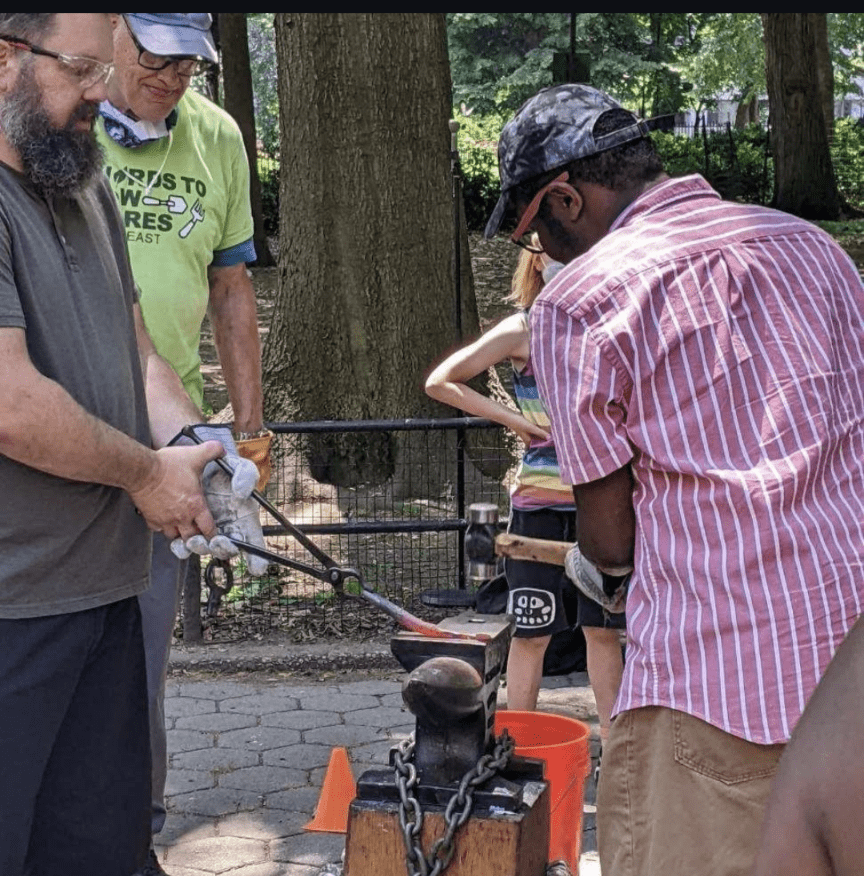
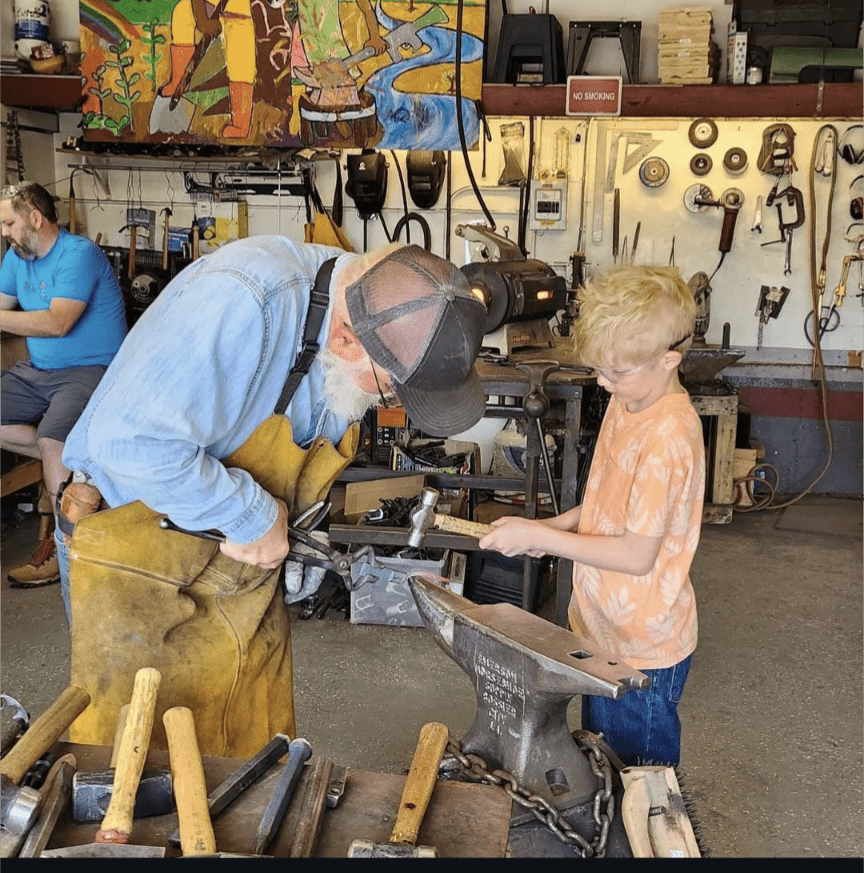
    RAWTools’ work of turning donated firearms into garden tools and works of art generates searing visual symbols and powerful emotions. But their work goes much farther and deeper than forge and blacksmithing activities. In my observation and in talking to Michael, the work of RAWTools is rooted in a commitment to walk with people who want to experience healing and who want to turn away from violence. The organization seeks to unleash creativity, foster dialogue across divides, and teach new ways of peacemaking and problem-solving.

    On their website, RAWTools asks the question, “What if we made a commitment to solve our problems without guns and violence?”

    Are you asking this question, too?

    I talked by phone with Michael the other day to ask him more questions about his unique ministry and his story. He told me more about the evolution of his unfolding ministry as a movement chaplain and how he was recently ordained by Mountain States Mennonite Conference. We also talked about his roles as a spouse and a father of sons, about living in the West, and about being a Mennonite Christian. What immediately stood out to me was Michael’s willingness to step out of either-or thinking, step out of entrenched divides and stereotypes, and step out of church walls to witness and encounter the Spirit’s transformative power in people’s lives. I was also struck and refreshed by hearing how his ministry brings together people whose backgrounds we might not expect to intersect: gun owners and survivors of gun violence.

    We talked about walking with people who have experienced fear and trauma, and about walking into public spaces with courage. Quite naturally, we started talking about Jesus. Referencing the Mennonite Men mission statement, I asked Michael what it means to him to follow Jesus for God’s shalom.

    “Jesus embodied solidarity with people who are being harmed. I think Jesus is calling people to risk something in this. Fellow Jesus followers—including men—are called to put their bodies between people being harmed. We are being called to put our reputations on the line. People in positions of power need to be vulnerable,” he responded.

    I asked Michael about the nature of RAWTools’ work and where he experiences God there.

    “A lot of RAWTools’ work happens iteratively. It’s Spirit-led. We work with folks who are survivors of gun violence. They’ve always been the guiding light. In those moments, I feel God’s presence the most,” he shared.

    That said, saying yes to this calling is no cakewalk for Michael.

    “In getting into this work with RAWTools, I had to work through the traumas of my own life. I’ve had to wrestle with my own sense of belovedness. Once I’d done some of that personal work, I felt more comfortable continuing to invest in where I felt God was moving.”

    If you or other men in your circles want to learn more about Michael’s ministry and his faith journey, visit the RAWTools website and consider coming to an upcoming men’s retreat in southwest Michigan. Mennonite Men is fortunate to have Michael as the speaker at its upcoming Men’s Retreat, Becoming Malleable Men, which runs from Friday night, March 6, to Sunday morning, March 8. Online registration can be found at https://friedenswald.org/retreats/.

    Photo credits: RAWTools.

  • Walking Together: An Invitation to Men

    Walking Together: An Invitation to Men

    One afternoon back in 2021, I crossed paths unexpectedly with a guy from church when we both pulled into the church parking lot about the same time, arriving before a gathering started. He was alone in his vehicle, head tilted back and looking exhausted. I went over to his van and we started catching up. To my surprise he told me he had just lost his job and his son was getting out of control at school and at home. After that conversation we started making more regular time for hanging out, usually around a backyard fire ring once his kids were put to bed. Our hangouts led to some humbling discoveries and confessions, as we both had really difficult personal stuff going on. The idea of forming a men’s group emerged. Would other guys in our congregation want to have deep conversations like we were having, to find ways to grow spiritually and encourage each other?

    The answer was yes!

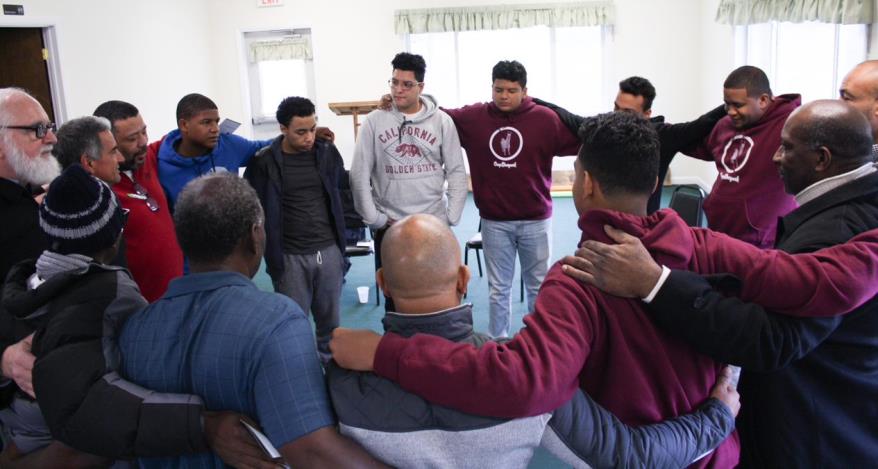
    It’s now been three years since our men’s group formed, and the gathering has transformed how I feel about church, male friendship, and myself. For one thing, this gathering is not for talking sports, weather, or gossip. Each time we gather, there is time for each man to check in about what’s going on in his life. We ask for volunteers to help facilitate and bring food, one man shares deeply from his life (or leads a teaching of sorts), and we open and close with prayer. We have ground rules that help structure our sharing and listening, and we read aloud words that remind us all that we are welcome and in God’s presence.

    Three years later, I still need this group. Why? Because it’s raw and unpolished. We confess and ask for help. We laugh. We sometimes say the wrong thing and hurt each other and have to apologize. We break bread together. In short, we are walking together. And it takes practice.

    I write not to brag, but to offer permission for guys to spend intentional time with other guys. Many men out there—including those within church communities—are lonely and don’t know how to find male friends and community. There’s no formula for how to start friendships with other guys or how to start a men’s group. Sometimes it starts with a simple text, phone call, email, or ‘Hey, how’s it goin’?’ when running into one other guy.

    Mennonite Men seeks to engage men to grow, give and serve as followers of Jesus for God’s shalom. We care about men, we pray for men, and we want to offer resources to men. Here are a few ideas and invitations—not a list of ‘shoulds’—for you or men in your life during this dark time of the year and as the new year approaches:

    • Revive contact with friends past and present. You might be surprised that guys you haven’t talked to in a while may be in the same boat: they mean to reach out, but haven’t gotten around to it. If someone takes initiative, it could lead to a great connection. Many people—including men—have a hard time during the holidays.
    • Seek support (beyond friends) if you need it. If you need to talk to someone who is trained to listen well and be a supportive resource, talk to a pastor, a therapist, a spiritual director, or a friend who might refer you to someone they recommend. This could include joining a men’s group or a support group. If you’ve got the energy, consider starting a group that has some sort of clear focus. Mennonite Men would love to be a sounding board if you want ideas (check out our website).
    • Spend time outside of our own bubble, encountering men in everyday situations where we can interact and bear witness as followers of Jesus. For me, joining a local gym creates opportunity to interact with other guys in the community I wouldn’t otherwise meet. Perhaps the Spirit may lead me to strike up conversation with brothers there who are struggling.
    • Go on a retreat, getting away from the fast-paced and technology-driven rhythms of daily life and work. Contact a retreat center near you. Check out Iluman’s website and their upcoming online or in-person men’s retreats. And if you haven’t heard, Mennonite Men is offering a men’s retreat at Camp Friedenswald March 6-8, 2026, with guest presenter Michael Martin of RAW Tools (registration is open).
    • Offer yourself in some form of in-person service to others. Maybe this looks like volunteering in the community, becoming a mentor at church or in a local school, visiting elders who are often alone, or doing repairs or yardwork for someone who just had surgery or a family emergency.

    We celebrate the birth of Jesus, who came to us as a child born into a dangerous world. And we anticipate a new year coming. Lean in. May you find ways to join with other men, and may you find that, in doing so, you discover new ways to connect with yourself, with Christ, and with God.


  • Mennonite Men and Indigenous Solidarity

    Mennonite Men and Indigenous Solidarity

    In recent years, Mennonite men have become directly involved in Indigenous solidarity work. Some of this has come to Mennonite Men as an organization through staff and board members; in other cases, individual men have initiated involvement on their own. In both cases, Mennonite men are being invited to show up, listen, and bear witness to realities that Indigenous persons have historically and currently faced. Mennonite men are being invited to pray with and for Indigenous siblings, to show care, build relationships, and raise their voices alongside Indigenous voices who are advocating for just treatment.

    I want to highlight two different Indigenous communities in the U.S. that are advocating for justice and with whom Mennonite men are getting involved. In both examples, Indigenous communities have invited involvement from the Coalition to Dismantle the Doctrine of Discovery (CDDoD).

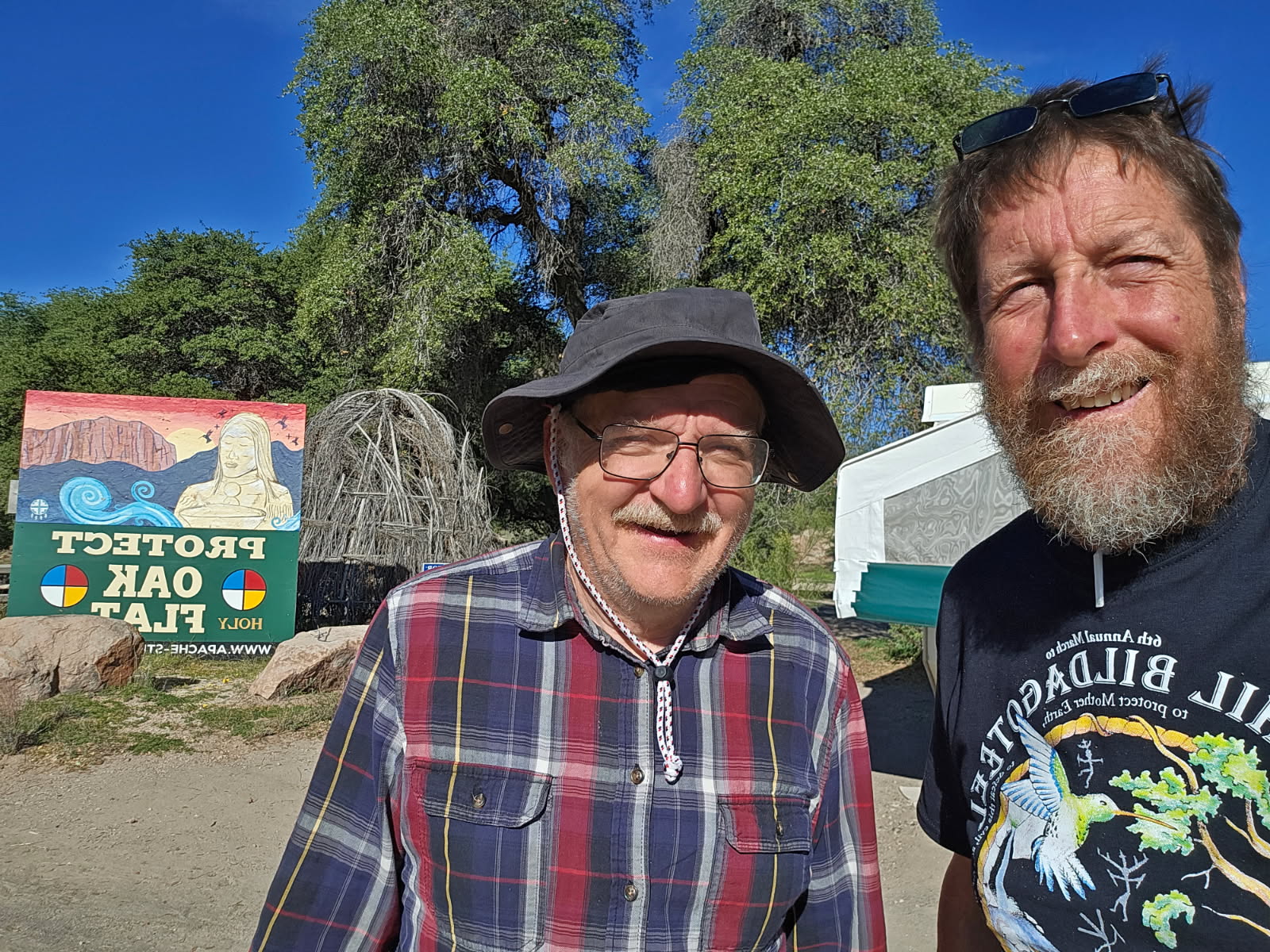
    The first example is at Oak Flat (Chi’Chil Bildagoteel), sacred land of the Western Apache in Arizona. Rich Meyer and David Baer of Benton Mennonite Church (IN) have been serving at Oak Flat to pray, learn from Apaches, offer accompaniment to Apache Stronghold when needed, and maintain the camp. Rich Meyer offers this reflection:

    “I knew coming here that I would need to be listening and learning—listening to the Apache, to teammates with experience, to God. In my daily walks here, I am able to really stop, wait, and listen much more deliberately than in my usual busy life.”

    Being at Oak Flat allows one to bear witness to the beauty of God’s creation and the injustices Oak Flat is slated to experience if the land is transferred to the copper mining company Resolution Copper. Efforts to protect Oak Flat and to stand with Apaches are not over. If you or your congregation would like to get involved in prayerful work where you are to support Apache Stronghold and sacred land, contact Molly@dismantlediscovery.org. If you are intereseted in joining pray-filled protective accompaniment at Oak Flat, or have someone to nominate for this work, contact Carol Rose at cofa@dismantlediscovery.org to explore options for training and serving on a team. You may also contact me at JonZ@MennoniteMen.org to hear about my personal experiences.

    Photo at right: Rich Meyer (R) and David Baer (L), both from Benton Mennonite Church in Goshen, at Oak Flat.

    The second example is from the Shinnecock Nation on the east end of Long Island, New York. After years of relationship-building that began with Sarah Augustine and Shinnecock leaders, Shinnecock leaders invited members of a new CDDoD working group to visit their reservation. This delegation in September of 2025 included Mennonite associate pastor Matt Carlson of Akron Mennonite Church in Pennsylvania, along with six others. Matt shared a reflection from his time with the delegation:

    We began our mornings together at a communal fire on their reservation to hear stories of their people and our hosts took us around the area to show us some of their sacred sites, some of which they’ve only recently regained access to. This is an example to me of yet another reversal. In the parable Jesus shared, the host is a person with power and resources who organizes the banquet and invites those who are socially marginalized. For those of us with power and resources, this is an appropriate and good expression of faith, sharing our resources with an open hand with those who are in need. I’m also left with the question, “What does it look like to give up that power, to relinquish our place at the head of the table?” After all, the stories of the Jesus we follow are all about giving up power, from being born as a baby in a stable, to resisting the temptations in the wilderness, to depending on the hospitality of others, to being crucified on a cross.’

    Matt also documents the various ways in which Shinnecock land has been stolen and treaties broken, as well as the ongoing pollution affecting the waters of Shinnecock Bay due to failing septic systems from homes in nearby Southampton. The Shinnecock people continue to experience disrespect and discrimination to this day and are entangled in many lawsuits.

    “Untreated wastewater from outdated septic systems and cesspools has been leaking into the groundwater and flowing into Shinnecock Bay. This is harming the bay, with excess nitrogen causing toxic algae blooms, which deplete oxygen and destroy the marine life that is an integral part of the Shinnecock culture and economy. In response to this crisis, a group of women leaders from the Shinnecock Nation have resurrected the ancient practice of raising sugar kelp in the waters of Shinnecock Bay. Kelp has the ability to sequester carbon and nitrogen, which will help heal the waters of the bay, and the harvested kelp can be sold as a natural fertilizer, supporting the Nation’s economy.

    “Raising kelp is one piece of a larger effort to maintain ancestral ties to the lands and waters that the Shinnecock Nation has stewarded for thousands of years. Unfortunately, continued development in the Hamptons and the unwillingness of local and state leadership to recognize the land rights of the Shinnecock Nation make that effort extremely difficult. The purpose of the delegation was to learn how those of us who are newcomers to this land can help support the various initiatives of the Shinnecock Nation. With guidance from Shinnecock leaders, and as part of a larger network of allies, we are working to build a campaign to aid the Shinnecock people in realizing their economic and cultural sovereignty.”

    I am encouraged to see men like Matt involved with CDDoD who live in closer geographical proximity to Long Island, as the issues, advocacy, and in-person visits could literally be closer to home. If you wish to learn more about the Shinnecock Working Group of CDDoD and get involved, please contact Alicia Maldonado-Zahra at amaldonadozahra@goshen.edu. If you wish to read Matt’s full article about what he learned during the Shinnecock delegation visit, you may email him at mcarlson@akronmench.org.

    Please pray for our Indigenous brothers and sisters who face daily hardship and disrespect. Also pray for Mennonite men and others who are feeling God’s call to build relationships and offer direct accompaniment to Indigenous communities pleading for justice.


  • A Foundation of Faith: JoinHands Grant Empowers Ghanaian Church Construction

    A Foundation of Faith: JoinHands Grant Empowers Ghanaian Church Construction


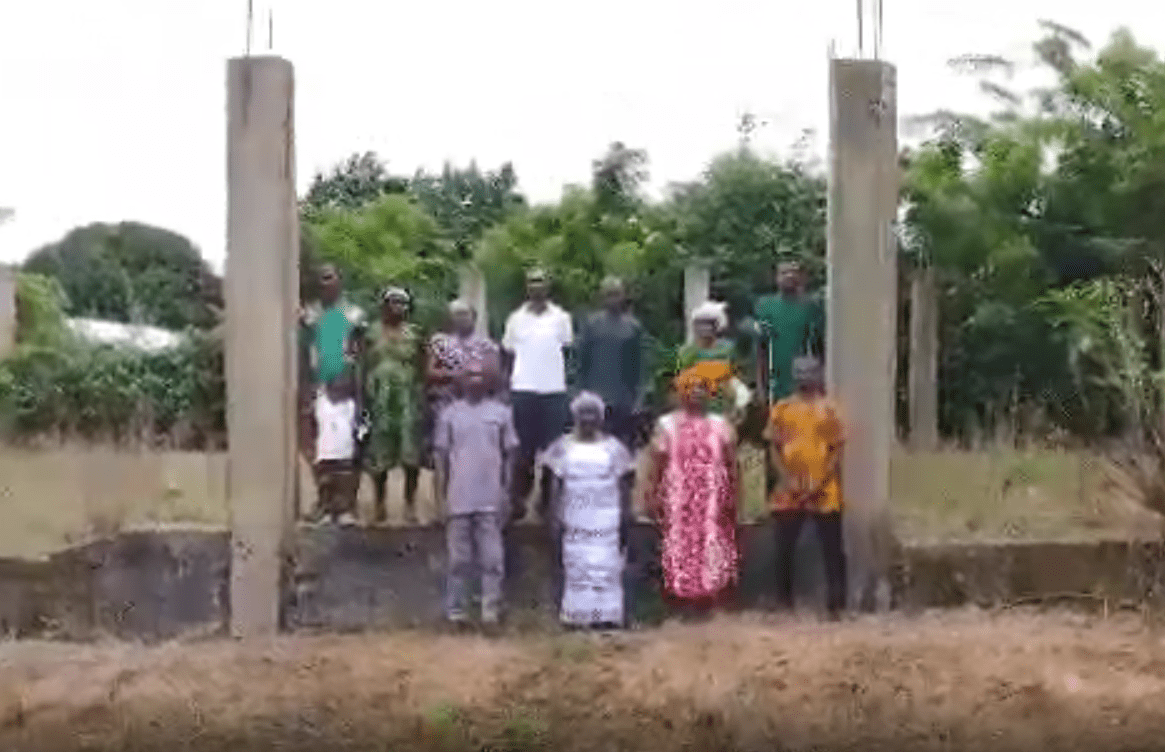
    In the spring of 2025, Mennonite Men was contacted by Matthew Krabill of Mennonite Mission Network, who is serving in Ghana, inquiring about JoinHands grants for a Ghanaian congregation seeking to build a place of worship. After receiving a JoinHands grant application for the Santramozorh Mennonite Church, Mennonite Men’s JoinHands committee engaged via email and Zoom in dialogue with Ghanaian pastor Francis Kwame Dzivor and with Krabill. What an honor it has been to hear stories and learn about this community’s worship setting, as well as to receive photos and videos from Ghana. We are humbled to learn that this community often worships outdoors under a large tree or in a bamboo structure open to the elements—a stark contrast to the large and comfortable indoor spaces where many of us worship here in the United States.

    Photo: members of the Santramozorh Mennonite Church next to previously erected pillars that will support the new church’s roof. (Matthew Krabill)

    At its October board meeting, Mennonite Men approved a grant for the Santramozorh Mennonite Church, a faith community of Ghana Mennonite Church in the eastern part of the country. Given Mennonite Men’s policies that limit the percentage we can give relative to a project’s total cost, this congregation is still seeking additional funding sources. We invite you to pray for Ghana Mennonite Church, particularly the Santramozorh congregation, Pastor Francis Kwame Dzivor, and their continued fundraising efforts to complete this building project. If you would like to inquire about additional ways to give, please email krabillm@tsinet.org to reach Matthew Krabill.

    We thank all who donate to Mennonite Men’s JoinHands ministry, which helps congregations with limited resources purchase or create secure spaces for worship. May God’s kin-dom flourish throughout the world, including among our brothers and sisters in Ghana.


  • A Place of Welcome in South Philadelphia

    A Place of Welcome in South Philadelphia

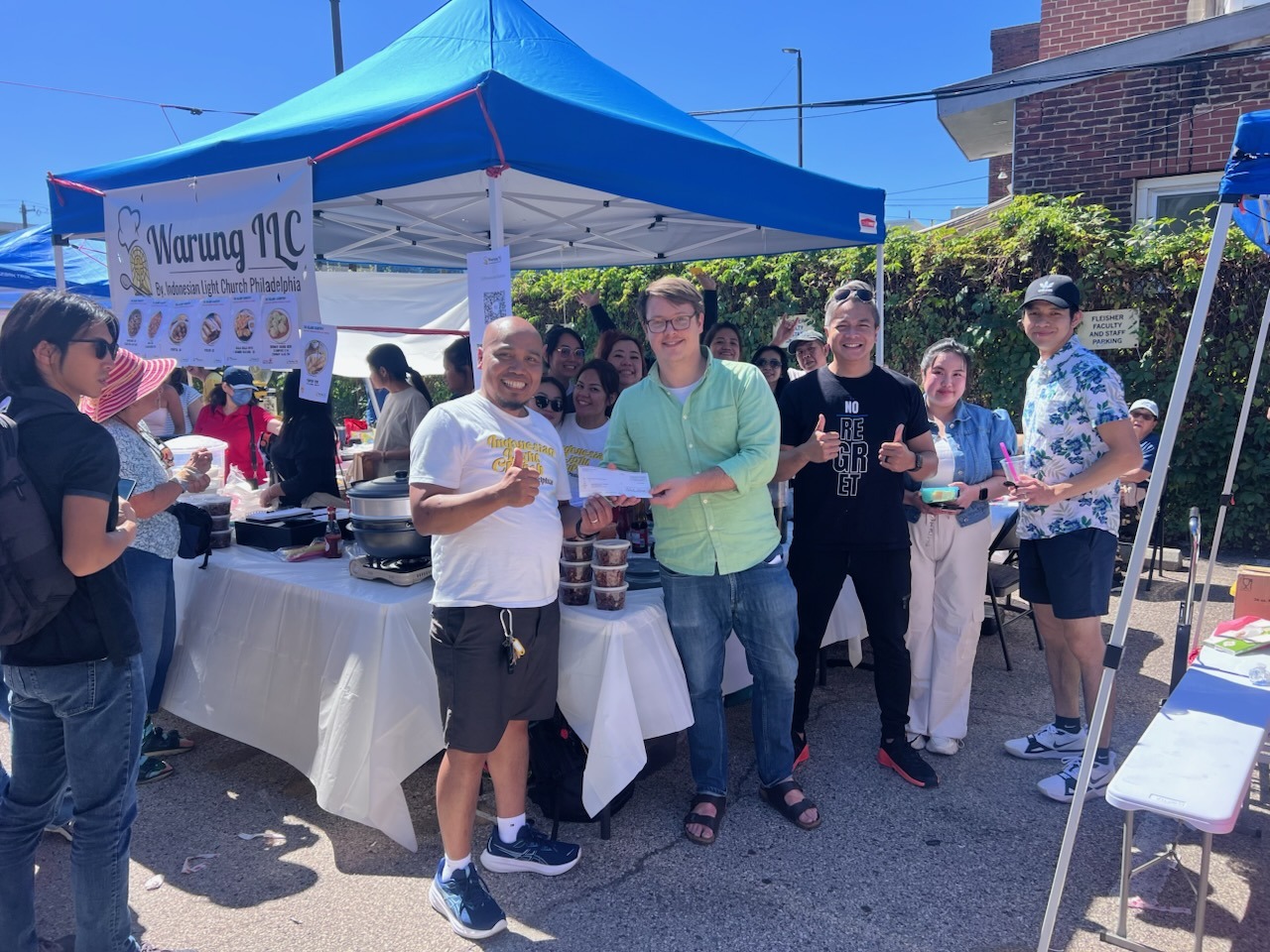
    When I arrived at the Indonesian Community Bazaar in South Philadelphia, I was greeted with warm smiles, a cold Thai tea, and a plate of delicious food. Members of Indonesian Light Church ushered me with excitement into the tent where they were selling home cooked food. I was there to present a grant check on behalf of Mennonite Men’s Join Hands program that helps congregations purchase their first church building. I was also being welcomed into their circle of hospitality.

    After the check presentation, Pastor Hendy Matahelemual invited me to tour the nearby building they hope to soon call their own. Since early 2024, Indonesian Light Church, a Mosaic Mennonite Conference congregation, has been renting this South Philadelphia church building on a month-to-month basis with the intent to purchase. Thanks to faithful giving and tireless fundraising—like the bazaar—I learned they are nearly at their down payment goal and expect to close by the end of September 2025.

    Indonesian Light is part of a large and growing Indonesian community in South Philadelphia. Many members are Chinese-Indonesian Christians, who faced persecution in Indonesia and sought asylum in the United States beginning in the late 1990s. Today, Christian and other minority groups in Indonesia continue to feel unsafe, and many still emigrate seeking refuge.

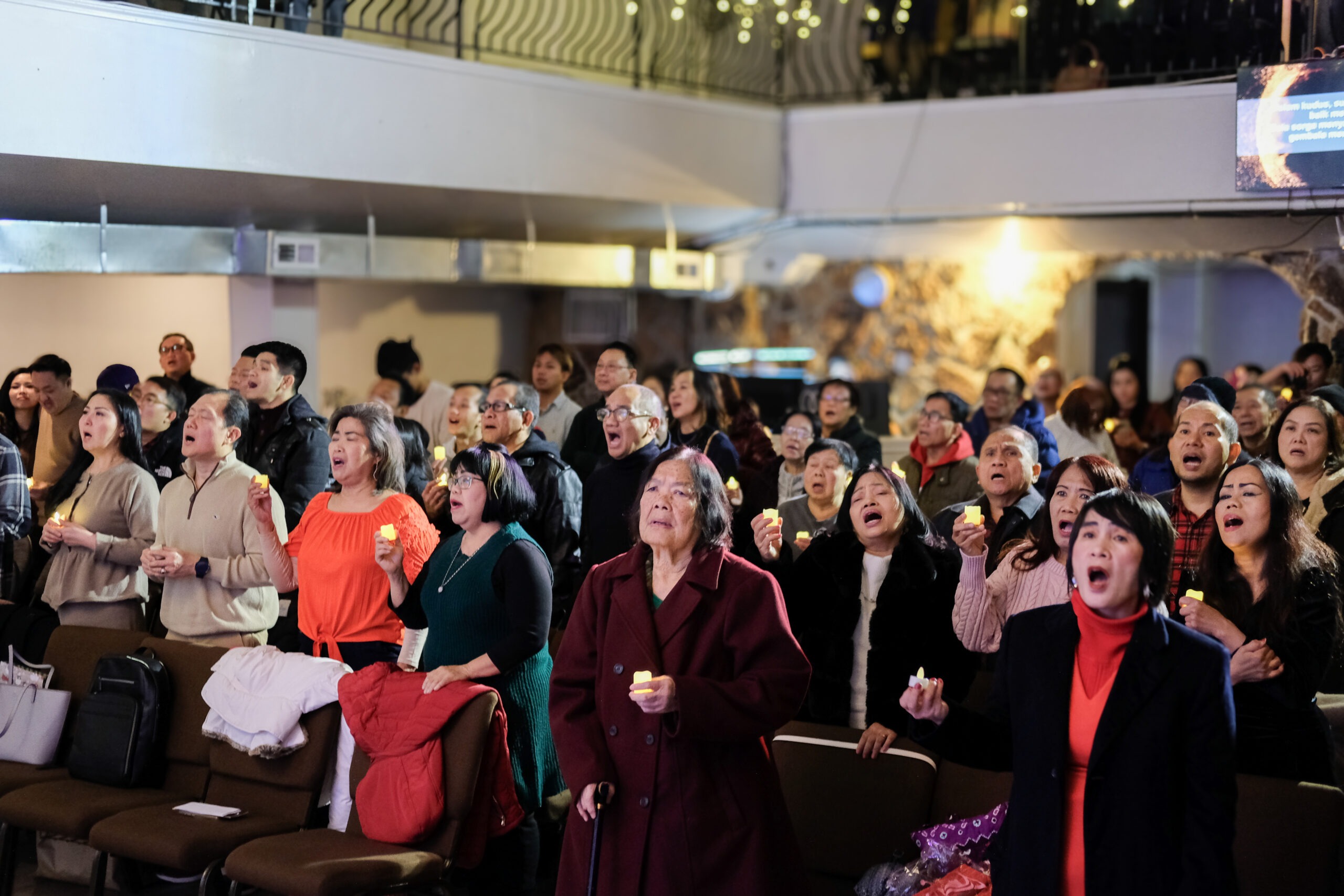
    Pastor Hendy explained how vital community is for those who arrive here: “Community is a huge part of Indonesian culture. When Indonesians move here, they search out a church community. In church you get connection, the community holds you accountable, and the pastor and community can vouch for you.”

    That spirit of welcome is lived out daily in the congregation. Members help newcomers find housing, jobs, and healthcare. Once established, those who were welcomed become welcomers in turn. “It’s organic,” Pastor Hendy said. “You don’t have to ask, they just do it.”

    Though recent anxieties around immigration have affected many members and so the congregation continues to lean into hope and hospitality. Their new space has already allowed them to double in attendance, share worship space with a Hispanic congregation, and host weekly AA and NA groups.

    Indonesian Light Church embodies what it means to be a welcoming community of faith—rooted in culture, strengthened by Anabaptist values, and open to the Spirit’s leading. I left filled with good food and encouraged by seeing their joy, hope, and hospitality flourishing in the city of brotherly love.

    If you’d like to learn more about or contribute to Mennonite Men’s JoinHands grant program, visit MennoniteMen.org/JoinHands.


  • The Land and Our Story

    The Land and Our Story

    Our Influences

    We both grew up with deep connections to the land. Both of us grew up on farms, where woods, fields, streams, and animals were a part of our daily lives. We watched our parents care for the land in the best ways that they knew how. We also both watched our parents struggle financially to be able to earn their livelihoods from the land.

    We also both grew up hearing hazy stories of Native Americans living on the lands before our times. Dan, growing up in northern New York state, heard stories of his grandfather going to Ontario to hire Native men to work on his farm. He passed through the land of the Onondaga Nation on his road trips while dating Jeanne. For Jeanne, growing up on this land in Ohio, it was finding ancient arrowheads in the fields and living near Little Chippewa Creek, which carried the name of one of the indigenous tribes of the land.

    The experience of working internationally from 1989-2017 in DR Congo, Nigeria, Indonesia, and across Southeast Asia opened our eyes to indigenous ways of viewing the land. Being outside our own context allowed us to reflect on our own family stories on the land that were part of each of our family’s identities.

    In Indonesia, we had the opportunity to develop long-term friendships with people who were indigenous to Papua. Papuan people live on the Indonesian-owned half of the island of New Guinea. As the native people of the coastal areas and highlands, they face the loss of their land, their forests, their culture, their languages, their health, and their right to self-determination on a daily basis. Their losses come at the hands of settlers from other parts of Indonesia, from international logging companies decimating the rainforest, and through the colonial power of Freeport, a US-owned company that operates the largest gold mine in the world out of a sacred mountain in Papua.

    Seeing the deep injustices faced by many Papuan friends caused us to self-reflect and to recognize the injustices that have been happening here in the United States to the land, the animals, the water and the people over the course of more than 500 years. Indigenous people have been almost completely wiped away from the memory of Ohio residents. Most of our friends cannot name the people groups who lived on this land before the white settlers. Their languages are no longer spoken here. Many of the animals and forests of the land have disappeared. Genealogy-loving Amish and Mennonite settler descendants narrate local history as if it began with the settlers’ arrival in the area. Many Wayne County residents assume that the landscape has always been open rolling agricultural fields.

    Time does not erase injustice, environmental degradation, and generational trauma for people who were forced to leave this land or for the land itself. In Papua, we could be allies and advocates walking alongside indigenous people. We came to realize that in the USA, our settler people have been the perpetrators and the beneficiaries of the violence to indigenous people and to the land, waters, forests, and animals.

    Since we returned to Ohio in 2017, we have been called more deeply into relationship to this land where we live. As people of faith, we have a calling to reconciliation and a restored relationship to the land and to the indigenous people whose history is also on this land. We are settlers, and we cannot become indigenous to this place. Yet we are ‘becoming naturalized’ to this place. In her book, Braiding Sweetgrass, Potowatami author and botanist Robin Wall Kimmerer writes:

    Being naturalized to a place means to live as if this is the land that feeds you, as if these are the streams from which you drink, that build your body and fill your spirit. To become naturalized is to know that your ancestors lie in this ground. Here you will give your gifts and meet your responsibilities. To become naturalized is to live as if your children’s future matters, to take care of the land as if our lives and the lives of all our relatives depend on it. Because they do.


    Some History

    The lands of Ohio have been inhabited by indigenous people for millennia. White settlers first came to Ohio in 1788. In the late 1700s and early 1800s, Ohio, known in the colonial world as the Northwest Territory, became one of the most violent places in what is now the United States. Native people fought American military forces for their ability to stay on the land.

    In 1794, General Anthony Wayne used scorched earth tactics to defeat the native Western Confederacy at the Battle of Fallen Timbers. The following year, in 1795, Wayne signed the Treaty of Greenville, which took away native land with a treaty line that runs with the watershed just south of what is now Wayne County.

    The official government assurance of the indigenous people’s right to be on the land did not last for perpetuity or even for ten years. White people began exploring additional Indian land as soon as the Greenville Treaty was signed. They first explored what is now Green Township in 1802. The exploration was not welcomed by indigenous people who understood the intentions of the white settlers. One of the first four white explorers was killed by Indians in the southwest corner of Section 3 of Green Township, less than a mile north from where we now live.

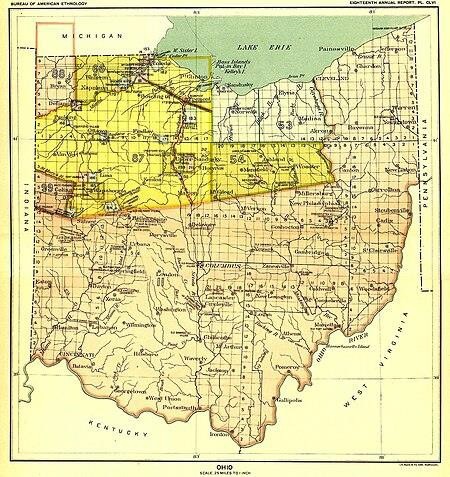
    Just ten years after the Greenville Treaty, the promises to Native people were reversed by the United States government, who had first made the promise. In 1805 the lines of Indian lands were redrawn with the Treaty of Fort Industry, which took away the lands of the Chippewa, the Delaware (Leni Lenape), the Munsee, the Ottawa, the Potawatomi, the Shawnee, and the Wyandot who signed the treaty under duress. The eastern boundary of Indian lands in northern Ohio was moved from the Tuscarawas River and Cuyahoga River westward to a line 120 miles west of the Pennsylvania boundary.


    The Treaty of Fort Industry signed away the land from Native people and expanded lands for settlers. The land (shown in the map in yellow) became the ‘property’ of the United States government.

    The grandson of an early settler described what is now Green Township as his grandfather recounted the story to him. ‘The Virgin forests were dense and beautiful, dark in aspect and deep beyond measure in magnitude. They were unbroken and interwoven with vines and underbrush. In many places, swamps, underbrush and high-ranking weeds covered the lowlands. Indians and wild animals roamed through the swamps and the dark avenues of the forest. Serpents and reptiles abounded in abundance over the land. The hawk, buzzard, and eagle proclaimed their dominion from the treetops. (History of Smithville by Paul G. Locher)

    The historian Benjamin Douglass wrote specifically about Green Township in his 1878 History of Wayne County. ‘The early inhabitants of this township observed one peculiarity in the first occupancy of it. It was a wilderness, overgrown with timber, with the exception of about twelve acres on the south-west quarter of Section three, which was clear of trees, stumps, and even roots, and was called by the early settlers, ‘the Indian’s Field’. If a twelve-acre field was notable to be mentioned in a local history, it was because of its contrast to the old growth forest that surrounded it. Green Township was not originally a place of sunny grassy meadows.

    Settlers initially saw the forests as a commodity to be harvested. Green Township is said to have had the heaviest and most plentiful timber of any township in the county. Historians noted red, white, and black oak, hickory, chestnut, walnut, maple, beech, ash and elm. Soon, the settlers saw the forests as an obstacle that needed to be overcome. They set about clearing the forests to make farms instead. David Stanley wrote in his personal memoirs:

    ‘The land was considered very thoroughly grubbed when the plough could run 10 feet without meeting a stump or root. The clearing of the land in those days embraced the girdling of the big timber, the grubbing out of all bushes less than 6 inches in diameter, and the cutting down and burning or removing of all saplings up to 10 inches…After the first clearing, the heavy deadened timber remained. Huge dead trees dotted over the fields, their bare bodies and naked limbs in the dusk of the evening, or the pale light of the moon having a most dismal and ghostlike appearance. The removal of this huge crop of dead trees was a giant task. Many of the trees 4 feet or more in diameter were chopped down. (and burned)… All consumed for no more purpose but to get rid of it. It had to be removed to make way for the cornfield. Burning of the heaps was a week’s work.’


    When the white settlers came, many acres of the Great Eastern Hardwood Forest were intentionally removed to make way for farming. The Great Eastern Hardwood Forest was said to be second only to the Amazon rainforest in terms of diversity of species. In the late 1700s, the forest cover in what is now the state of Ohio was estimated at 95 percent. Massive forest clearing for crop production dropped the forest cover to just 10% of the state by 1910. Today, about 30% of Ohio is forested.


    The Arrival of Our People

    Amish Mennonite settlers began moving to what is now Green Township from Somerset County, Pennsylvania to take advantage of this ‘available’ land to which they could now have a clear title. Land could be purchased directly from the United States government with land patents signed by the President of the United States.

    I adapted Wendell Berry’s poem originally written about his home in Kentucky. My changes are in parentheses.

    From (Pennsylvania) they came to wilderness old past knowing, to them new.

    A quiet resided here, into which come these new ones,

    minds full of purpose, loud, small, reductive, prone to disappointment.

    They surveyed their places in it, established possession.

    (‘From the Tuscarawas River and Cuyahoga River westward to a line 120 miles west of the Pennsylvania boundary.’)

    Within that figment geography of random landmarks, the trees were felled. The plows scribed their lasting passages, exposing the ground to the sky.

    The hot sun and hard rain then came down upon it, undeflected by a shadow or a leaf.

    What was there that they so much wanted to change?

    They wanted a farm, not a forest.

    From then to now, no caring thought was given to these slopes ever tending lower.

    Thus nature’s gift, her wealth and ours, is borne downstream, cluttering the bottom lands in passing,

    and finally, is lost at sea.


    As the Amish Mennonite and other settlers came to this land that would be called Green Township, they were surely aware of the presence of the native people who had so recently occupied the land before their arrival. They knew about the twelve-acre cleared field. John Winkler, an early settler in Green Township, remembered that there was an Indian Camp at Crouse’s farm between Paradise and Smithville. He remembered that they were peaceable and frequently returned to visit their old hunting grounds.

    After the Treaty of Fort Industry in 1805, the United States government kept working to intentionally remove the indigenous inhabitants of Ohio. The Wyandot were the last to be removed from the state in 1843 through a series of treaties negotiated on behalf of white settlers. The Shawnee now live in Oklahoma. The Wyandot were removed to Kansas. Some Leni Lenape went to Canada.

    The people were lost. The forests were lost. Some animals, like the formerly abundant passenger pigeons, were lost to extinction. Much soil was lost.


    The Land Where We Live

    John Stutzman, an Amish Mennonite from Somerset County, Pennsylvania arrived on the land where we live in 1814 at age 16. He claimed and purchased 320 acres of Section 10 of Green Township. He received a patent for the land from President James Monroe. According to the Treaty of Fort Industry, when the ownership of the land changed from the US government to John Stutzman, native people were no longer allowed to use the land for hunting.
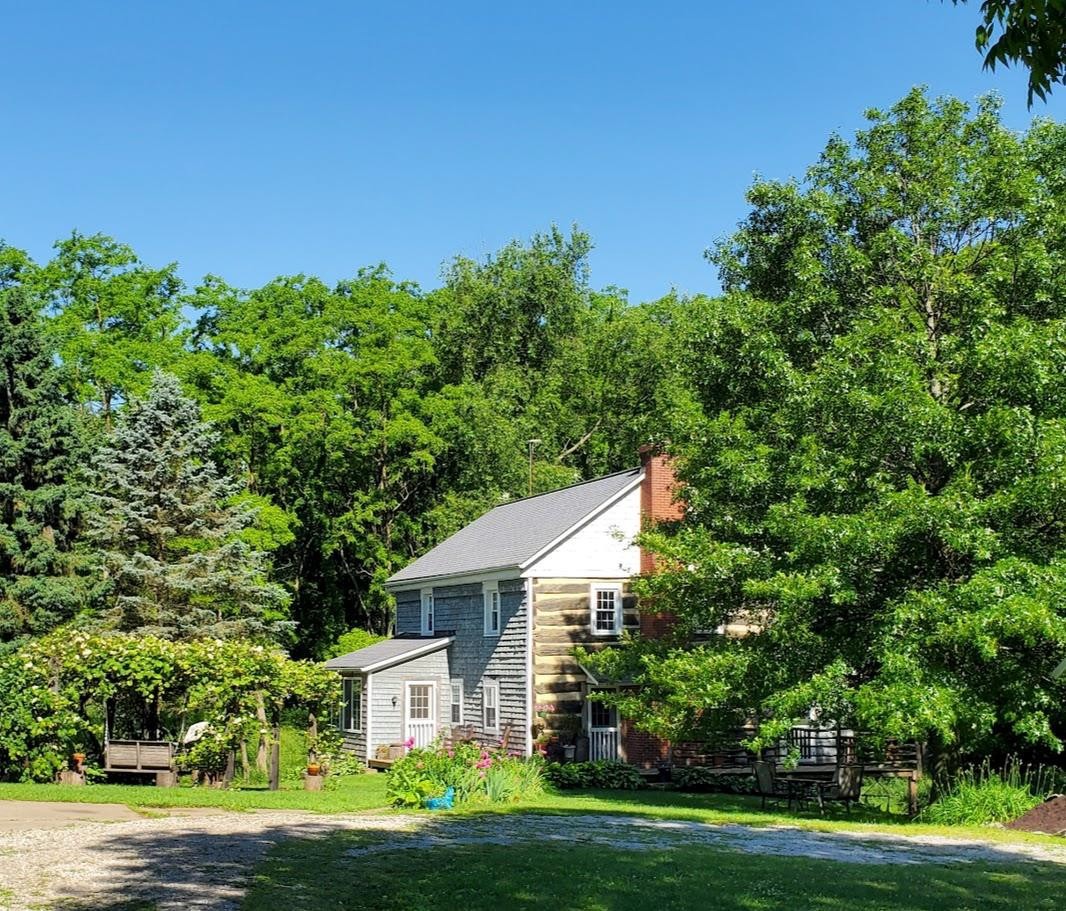
    The 76 acres and the house where we now live was a part of the 320+ acres owned by John and Sarah Stutzman. With all those acres to choose from, John and Sarah Stutzman chose this particular spot for a house, at a time when there were only three other houses anywhere in Section 10. It is beautifully situated among rolling hills and between two springs.

    John and Sarah Stutzman were some of the original members of the Oak Grove Amish Mennonite Church. Because the church did yet have a cemetery, it makes sense that family members who died before 1854 are buried on the farm. There may also be native gravesites.

    John and Sarah Stutzman had 13 children over a period of 22 years. The deaths we are aware of include:

    1829: Infant boy (age 2)
    1833: John Stutzman (age 2) 1834: Freeman Stutzman (infant) 1844: Christina Stutzman (age 1)
    1845: Anna Stutzman (age 15)
    1854: Lydia (Harmon) Stutzman (age 24 of typhoid)
    1854: John Stutzman (age 52 in the same typhoid epidemic)

    We assume that all these people are buried on the land. A registered cemetery in the northeast corner of the land has just one remaining marker for Lydia (Harmon) Stutzman, wife of David B. Stutzman and daughter-in-law to John and Sarah. She died in a typhoid epidemic on August 15, 1854, aged 22 years, 10 months, and three days.

    Sarah (Blough) Stutzman, John’s widow, died much later at the age of 78. She was buried in 1880 in at Oak Grove Mennonite Church, which had a cemetery by that time.

    A Stutzman descendent sold this land to William Crites sometime before 1908. My grandparents, Aldine and Velma (Steiner) Zimmerly bought the eighty-acre farm from Emanuel Crites in 1932. My grandma’s family were Amish Mennonite settlers and my grandpa’s family were Swiss Mennonite settlers who both came from settler farms within two miles of this land. With generational connections to this land, the Stutzman family, the Crites family, and the Zimmerly family are the only families to have lived on the land since 1814.

    My grandparents loved this land and struggled to keep it during difficult times, especially during my Grandma’s serious illness. My Grandpa Aldine sold the farm to my Grandma, Velma, in 1950 for $1. In 1960, my dad, Glenn, wrote home from Indonesia (where they were serving with MCC) ‘If you are having difficulties with the money end of it, Martha and I can at least help with several hundred dollars. Just write and tell us and we can have it sent from the bank at Wooster. Oh yes, don’t sell the farm!’

    Aldine and Velma took out a mortgage on the farm in 1963. My grandparents sold the farm to my parents, Glenn and Martha, in 1966 for $1. Glenn and Martha took out another mortgage in 1966. Both my grandpa and my dad worked in other jobs to be able to keep the land. My parents eventually expanded their acreage by purchasing the farm of my great grandparents, Jacob and Anna Zimmerly and another acreage both in Section 14 of Green Township.

    The farm was finally paid off with an inheritance from my maternal grandfather in the late 1990s. In 1998, my parents gathered their two children and their families to discuss the future of the land.

    They wanted to do an agricultural easement or to donate the land for mission. They eventually decided to keep the land to allow my brother’s family and our family to continue to serve and volunteer in ways that would not guarantee a retirement income.

    After the death of my mother in 2002 and my dad in 2006, my brother’s family and our family inherited the land. We sold off the other two farms so that my brother could purchase a farm in Ontario. We eventually returned to the home farm in 2017.


    Donating a Conservation Easement

    Our family has deeply loved and cared for this land for generations. In some ways, we depend on the land as our retirement plan. Yet the land is stolen land. Because of our experiences, we no longer think of the land as a commodity or refer to it as a ‘property.’ The land is the land. We live on it and have a responsibility for it.

    Joy Harjo, the 23rd Poet Laureate of the United States, a member of the Mvskoke (Muscogee Creek) Nation, writes

    Bless us, these lands, said the rememberer.

    These lands aren’t our lands. These lands aren’t your lands.

    We are this land.

    Tarhe the Crane, a Wyandot chief, eventually signed the Greenville Treaty in 1795. Still, he believed that no one owned the land and no one had the right to sell it out from under anyone. Tarhe explained his understanding of the land to Anthony Wayne, the military general who had ‘won’ the land.

    It belongs in common to us all. No earthly being has an exclusive right to it. The Great Spirit above is the only true and right owner of the soil; and he has given us an equal right to it.’ (Mary Stockwell, The Other Trail of Tears: The Removal of Ohio Indians; Westholme, 2016)


    This echoes our own Anabaptist faith tradition. David the psalmist declares in Psalm 24: ‘The earth is the Lord’s and everything in it, the world and its inhabitants too.’

    Our son, Ben, proclaimed this when we visited Ohio from Congo on a home leave when he was three. We had been living in a village in what is now DR Congo on traditional lands, held communally. In Ohio, Ben asked to walk across my uncle’s fields to a woods that he could see in the distance. When we explained that he didn’t have permission because those woods belonged to someone else, he became indignant and confused. ‘How can those woods belong to someone? They belong to God!’

    Author Wendell Berry reflects the settler paradigm of property/title, but still sees the land as a gift and our responsibility to be the land’s caretakers. He writes,

    ‘The ecological teaching of the Bible is simply inescapable. God made the world because He wanted it made. He thinks the world is good and He loves it. It is His world. He has never relinquished title to it. And He has never revoked the conditions bearing on his gift to us of the use of it, that oblige us to take excellent care of it.’


    Over the years, my parents, Glenn and Martha Zimmerly, cared for the land in the best way they knew as an expression of their faith. We inherited my dad’s copy of the book, Earthkeepers by his friends, Art and Jocele Meyer, with chapter titles of ‘New Testament Environmental Ethic’ and ‘Ecojustice: a Theology of Ecology.’ My dad taught vocational agriculture and was an early adopter of conservation practices including contour farming, no-till planting, grass waterways, afforestation of a ravine and a wildlife pond built with government conservation assistance.

    <
  • Mennonite Men Awards $40,000 JoinHands Grant to Indonesian Light Church for Building Purchase

    Mennonite Men Awards $40,000 JoinHands Grant to Indonesian Light Church for Building Purchase

    The Mennonite Men Board has approved a $40,000 grant through the JoinHands program to support Indonesian Light Church of Mosaic Mennonite Conference in purchasing the building they currently occupy. This grant will help the church secure a permanent home for its growing congregation, allowing them to continue serving their community and expanding their outreach to new immigrants in the area.

    Steve Kriss, Executive Conference Minister of Mosaic Mennonite Conference, expressed deep gratitude for the spirit of generosity that has fueled several grants to the Conference. He highlighted the significant role that Eastern District played in investing in Mennonite Men’s JoinHands initiative, which has helped fund projects across the nation.

    Indonesian Light Church, with a membership of 100, serves a vibrant and growing immigrant community in Philadelphia, PA.

    Philadelphia is a hub for new immigrants from around the world, including Indonesia, where many come seeking refuge from political unrest and religious persecution, especially those of Christian faith. The church has become an essential resource for these new arrivals, offering a place of worship, support, and fellowship. The need for a permanent space has become even more urgent as Indonesian Light Church continues to grow, with new members joining almost every week.

    The opportunity to purchase the building they currently occupy came as a rare blessing—a chance to secure a well-maintained property that will serve as a long-term home for their ministry. ‘We decided to buy this church building because it was a rare opportunity to secure a good property that was in great shape,’ said a church representative. ‘This will allow us to continue serving our expanding community.’

    ‘We are deeply grateful to Mennonite Men for awarding Indonesian Light Church the JoinHands Grant of $40,000 to help us purchase our first church building,’ said Hendy Matahelemual, pastor of Indonesian Light. ‘As an immigrant community in the U.S., a church building is more than just a place of worship—it is a safe space for gathering, a community hub, and a home where we can grow together in faith and fellowship. This support means the world to us, and we are forever thankful for this incredible blessing.’

    With the $40,000 grant from Mennonite Men, Indonesian Light Church is one step closer to securing their future and continuing their mission of faith, fellowship, and support for immigrants in Philadelphia. The congregation looks forward to the next chapter of their journey and the continued partnerships that will help sustain their ministry.

    For more information about the JoinHands program or Mennonite Men, or to contribute to to future JoinHands grants, please visit MennoniteMen.org/JoinHands.


  • Mennonite Men welcomes Jon Zirkle to co-leadership role

    Jon brings a background in agriculture, land conservation, not-for-profit leadership, environmental education, and theological training. Jon is a member of Assembly Mennonite Church in Goshen where he helped form a men’s group. He has an MA in Plant and Soil Science from University of Vermont and is a recent graduate of Anabaptist Mennonite Biblical Seminary with a M.A. in Christian Formation.

    Jon will primarily focus on the JoinMen ministry for men and JoinHands grantmaking for new churches while Steve’s focus will remain on development and the JoinTrees campaign for climate action. Jon will also coordinate growing involvement with Indigenous justice in partnership with the Coalition to Dismantle the Doctrine of Discovery.

    ‘I’m excited to work together with Jon,’ says Steve. ‘He is passionate about integrating spiritual formation, social justice, and creation care with men. With his gifts and experience, Jon will provide strong leadership for our mission to engage men to grow, give, and serve as followers of Jesus for God’s shalom.’

    The job-sharing arrangement was first prompted by Steve’s cancer diagnosis and successful treatment. Of Jon’s co-leadership, Steve believes that, ‘as a younger man Jon will help us navigate the next stage of Mennonite Men’s ministry in MC USA.’

    In addition to working with Mennonite Men, Jon directs Bushelcraft Farm, an educational farm in Elkhart, IN he co-founded in 2020, and has worked for the land trust Wood-Land-Lakes that protects Indiana land from development. Jon notes that his ‘small-scale agriculture and environmental work gives [him] perspective on ways that [he has] seen men find meaningful contributions beyond themselves and find connection to the Earth—God’s creation.’

    Jon is attracted to the holistic nature of Mennonite Men’s intent to be refreshing and challenging by engaging men with a focus on the ways of Jesus. ‘Men who are Mennonite need spiritual support and community with other men,’ he shared. ‘I too was missing deeper community and spiritual support. Mennonite Men truly is helping men grow. It’s an organization promoting healthy, faith-motivated men who are ready to listen, serve, tend to their inner life and outer lives, and walk alongside others seeking justice in the world.’

    Jon brings a vision of reaching younger men with diverse backgrounds and life experiences who are seeking community, friendship, and encouragement to deepen their spiritual lives.

    ‘Many of us men have not felt we have permission or much reason to truly know ourselves—our personality type, our source of pain, our desires, our identities as God’s Beloved,’ shares Jon. ‘This is essential work to invest time in, and needs to happen simultaneously with ‘outer work.’ Integrating prayer, community, and gratitude to God into our work is important, life-giving, and also challenging. I look forward to supporting fellow men in the journey of slowing down, identifying their core wounds, releasing control to God, prioritizing relationships, and seeking community.’

    In his work with JoinMen, he will develop new ways to connect with men through retreats, exploration of prayer practices, activism and justice work, outdoor experiences, promoting men’s groups and individual spiritual care, and volunteering in the community.

    Jon’s leadership will facilitate Mennonite Men’s growing involvement with Indigenous justice in partnership with the Coalition to Dismantle the Doctrine of Discovery. Of this connection, he says, ‘I am inspired to see Mennonite Men get relationally involved with indigenous communities and their struggles. I think many non-indigenous men could benefit from experiencing the power of worshipping outside, singing and dancing together, rediscovering rites of passage for boys and men, and finding inspiration to approach life with greater reverence, gratitude, prayer, celebration, and commitment to future generations.’

    Jon brings ‘tend the earth gifts’ as well as interests in both the internal and external aspects of faith formation that are a huge asset to Mennonite Men at this stage of its ministry to Mennonite Church USA.

  • Living that Matters in Retirement – Cancelled

    Come and experience a company of brothers seeking a meaningful life that matters in retirement.

    Location: The Hermitage
    11321 Dutch Settlement Rd, Three Rivers, MI 49093

    Date: 5:00 Friday – 4:30 Saturday, October 18-19

    Cost: Suggested donation range of $120-150. (Includes room, meals, and Living that Matters: Honest Conversations for Men of Faith)

    Registration: see form below. Register by September 15. Limited to the first 12 registrations with a $50 deposit.

    Flyer: download and print or share the digital flyer HERE


  • Miguel Rodriguez Hernandez

    Miguel is an Achí Maya farmer living in the village of Chup, Baja Verapaz, Guatemala. He was born September 30, 1958 and feels that in his 63 years he has been able to achieve progress for himself and his family. His principle occupation is farming, but in addition he is a leader in his community, serving as secretary of the COCODE, the Chup development committee, and as a local health promoter. He is currently secretary of his church council and, given that he can read and write, he has held several positions within his church. He states that these community responsibilities are a way to give thanks to God and fulfill the Creator’s teachings.

    As a child Miguel was able to study only through 6th grade. He remembers having to walk an hour to school without shoes. The school in the neighboring village of Patzocón was constructed of wooden poles and adobe mud and had 40 children of various grades in the one small classroom. The teachers were very strict, punishing any misconduct. Miguel feels he learned there to be very disciplined. When he wasn’t in school he worked at his father’s side growing corn, beans, and coffee. At this young age he learned basic agricultural skills, many of which he continues to use today.

    When Miguel was 16 years old the family’s corn harvest was not sufficient to last the year, and they did not have enough to eat, Manuel and his brothers decided to go to the plantations on Guatemala’s Pacific coast to find work to sustain the family. There Miguel worked planting sesame, picking coffee, and cutting sugar cane. Cutting and carrying sugar cane was arduous labor in heat over 100 degrees. He was paid $1 per day for 12 hours of work, earning $30 a month.

    After the death of his father, he married Manuela who has been his companion for life. Together they have 5 children. Presently he dedicates himself to cultivating corn and beans, helping Manuela with her large vegetable garden, and taking care of their chickens, pigs, and cows. Their farming gives them a sustainable food supply, plus some money for other purchases. He is working towards having a hillside of coffee trees. He has a small coffee tree nursery and he hopes to plant his coffee seedlings there next year.

    Miguel said with conviction, ‘I believe that while we have life there is hope.’ He has struggled all of his life to succeed as a farmer and to be a responsible father and community member. HIs dream is that the members of his community will plant the seedlings he is growing on the mountainsides around his village and continue to care for them and that this will improve the environment for his community.