Author: Admin account

  • Learning to Listen

    Learning to Listen

    As a co-director of Mennonite Men, it feels important to get to know Mennonite males from around the country and reflect on unique and shared experiences. Turns out that traveling to the far reaches of the US is not so affordable. And while phone and Zoom calls aren’t quite the same as meeting in-person, they are great ways to listen to, share with, and learn from other men working at being followers of Jesus for God’s shalom.

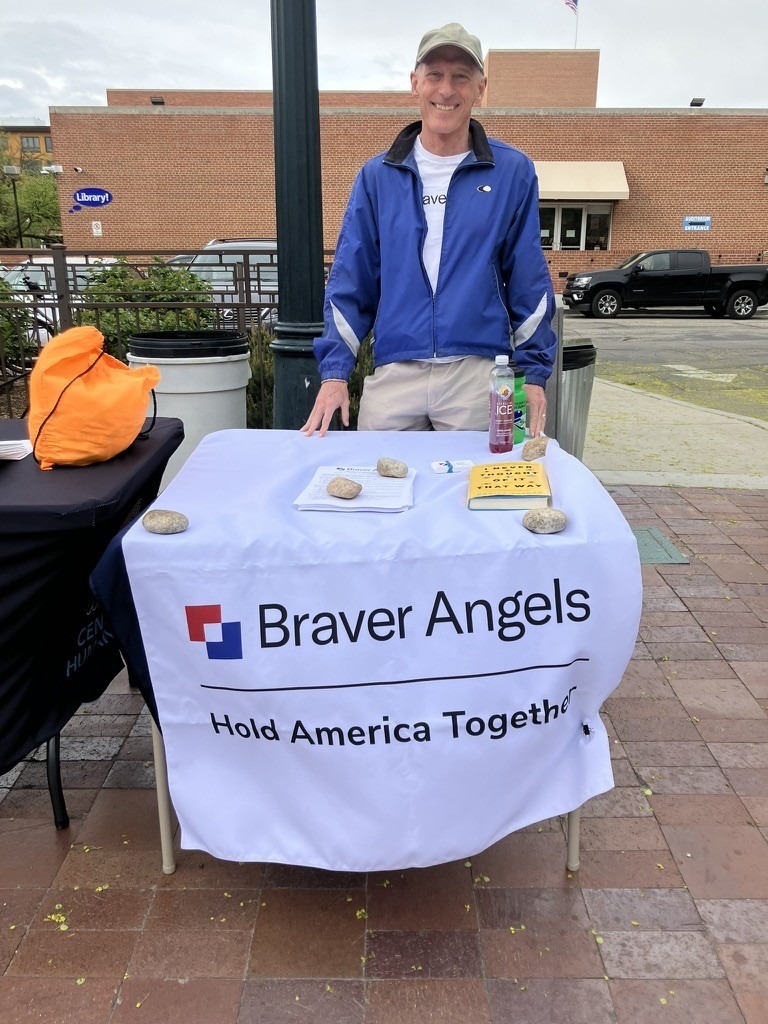
    I recently had a virtual conversation with a fellow Mennonite male in Idaho, Rob Hanson, thanks to an introduction from contacts in Pacific Northwest Mennonite Conference. Rather quickly I discovered Rob and I share several passions including conservation, agriculture, soil, and forests. God’s creation clearly means a lot to Rob. But I also sensed Rob’s care for relationships and the well-being of people as well as concerns about violence and poverty in the world. Rob is part of a bagel breakfast men’s group with other men in the congregation where he attends in Boise, Hyde Park Mennonite Fellowship. I was grateful to connect about shared experiences and have much to learn from Rob.

    Photo: Rob Hanson, provided by himself.

    Rob grew up evangelical and his wife grew up Catholic. Their journey to Mennonite Christian faith has been decades in the making. I was honored to hear about Rob’s faith journey and lessons learned along the way. We talked about our younger years, our younger selves, and our faith development and perspectives as we’ve encountered people with differing beliefs and perspectives.

    “As a male growing up, I thought it wasn’t okay to be wrong or to admit that I didn’t know the answer to something. As I get older, I’m letting go of these notions,” Rob shared.

    He gave an example from real life. “After moving to Idaho, I realized there are many Latter Day Saints folks in my area. Growing up, I was taught that the Church of LDS was a cult. Now I open my heart to them.”

    Soon our conversation led to talking about Rob’s involvement in the work of Braver Angels, an organization that his congregation has supported. Braver Angels is a non-partisan civic organization that welcomes peopel of all faiths and brings together people of polarized political viewpoints to respectfully listen to one another, practice dialogue, and build connection despite difference. Thanks to their pastor and a pastoral intern at the time, Hyde Park Mennonite Fellowship has hosted Braver Angels workshops. Rob and others in the congregation have gotten training to be moderators at these workshops. This work has become a ministry.

    I asked Rob how he is working to follow Jesus for God’s shalom these days, a reference to the mission statement of Mennonite Men. Rob directly referenced his involvement in Braver Angels in response.

    “Participating in Braver Angels gives me conversation skills I find important in trying to be a peacemaker,” he told me. “This all takes practice. It’s kinda an art. This work helps show me what my conflict triggers are and helps me learn to be curious about other people’s values… Braver Angels has helped me see others as whole people. Every person is worthy of dignity and respect and honesty. We are all made in the image of God. Through this work I get practice seeing Christ in other people, seeing the holiness in each other. God loves them just as much as He loves me.”

    As men trying to follow Jesus for God’s shalom, Mennonite Men is often trying to redefine what it means to be brave, to be strong, especially when the wider culture associates violence and domination with male bravery and strength. Rob again drew on Braver Angels in response.

    “If I am saved by Jesus, what is there to fear? By getting involved in Braver Angels, I’m trying to convey to others I meet that ‘I wish you the best. I don’t wish you harm.’ I’m learning how to talk to anyone and not be afraid to. That’s a form of bravery,” Rob shared.

    I learned so much in my short conversation with Rob. May you and other males—Mennonites and non-Mennonites!—find encouragement in following Jesus for God’s shalom, as well. To learn more about Braver Angels, visit https://braverangels.org or contact Rob Hanson directly at rhanson@braverangels.org. For more online resources for men’s groups and for spiritual growth, check out our JoinMen tab on our website at mennonitemen.org/joinmen, reach out to us directly, and consider donating to our cause.


  • The Land and Our Story

    The Land and Our Story

    Our Influences

    We both grew up with deep connections to the land. Both of us grew up on farms, where woods, fields, streams, and animals were a part of our daily lives. We watched our parents care for the land in the best ways that they knew how. We also both watched our parents struggle financially to be able to earn their livelihoods from the land.

    We also both grew up hearing hazy stories of Native Americans living on the lands before our times. Dan, growing up in northern New York state, heard stories of his grandfather going to Ontario to hire Native men to work on his farm. He passed through the land of the Onondaga Nation on his road trips while dating Jeanne. For Jeanne, growing up on this land in Ohio, it was finding ancient arrowheads in the fields and living near Little Chippewa Creek, which carried the name of one of the indigenous tribes of the land.

    The experience of working internationally from 1989-2017 in DR Congo, Nigeria, Indonesia, and across Southeast Asia opened our eyes to indigenous ways of viewing the land. Being outside our own context allowed us to reflect on our own family stories on the land that were part of each of our family’s identities.

    In Indonesia, we had the opportunity to develop long-term friendships with people who were indigenous to Papua. Papuan people live on the Indonesian-owned half of the island of New Guinea. As the native people of the coastal areas and highlands, they face the loss of their land, their forests, their culture, their languages, their health, and their right to self-determination on a daily basis. Their losses come at the hands of settlers from other parts of Indonesia, from international logging companies decimating the rainforest, and through the colonial power of Freeport, a US-owned company that operates the largest gold mine in the world out of a sacred mountain in Papua.

    Seeing the deep injustices faced by many Papuan friends caused us to self-reflect and to recognize the injustices that have been happening here in the United States to the land, the animals, the water and the people over the course of more than 500 years. Indigenous people have been almost completely wiped away from the memory of Ohio residents. Most of our friends cannot name the people groups who lived on this land before the white settlers. Their languages are no longer spoken here. Many of the animals and forests of the land have disappeared. Genealogy-loving Amish and Mennonite settler descendants narrate local history as if it began with the settlers’ arrival in the area. Many Wayne County residents assume that the landscape has always been open rolling agricultural fields.

    Time does not erase injustice, environmental degradation, and generational trauma for people who were forced to leave this land or for the land itself. In Papua, we could be allies and advocates walking alongside indigenous people. We came to realize that in the USA, our settler people have been the perpetrators and the beneficiaries of the violence to indigenous people and to the land, waters, forests, and animals.

    Since we returned to Ohio in 2017, we have been called more deeply into relationship to this land where we live. As people of faith, we have a calling to reconciliation and a restored relationship to the land and to the indigenous people whose history is also on this land. We are settlers, and we cannot become indigenous to this place. Yet we are ‘becoming naturalized’ to this place. In her book, Braiding Sweetgrass, Potowatami author and botanist Robin Wall Kimmerer writes:

    Being naturalized to a place means to live as if this is the land that feeds you, as if these are the streams from which you drink, that build your body and fill your spirit. To become naturalized is to know that your ancestors lie in this ground. Here you will give your gifts and meet your responsibilities. To become naturalized is to live as if your children’s future matters, to take care of the land as if our lives and the lives of all our relatives depend on it. Because they do.


    Some History

    The lands of Ohio have been inhabited by indigenous people for millennia. White settlers first came to Ohio in 1788. In the late 1700s and early 1800s, Ohio, known in the colonial world as the Northwest Territory, became one of the most violent places in what is now the United States. Native people fought American military forces for their ability to stay on the land.

    In 1794, General Anthony Wayne used scorched earth tactics to defeat the native Western Confederacy at the Battle of Fallen Timbers. The following year, in 1795, Wayne signed the Treaty of Greenville, which took away native land with a treaty line that runs with the watershed just south of what is now Wayne County.

    The official government assurance of the indigenous people’s right to be on the land did not last for perpetuity or even for ten years. White people began exploring additional Indian land as soon as the Greenville Treaty was signed. They first explored what is now Green Township in 1802. The exploration was not welcomed by indigenous people who understood the intentions of the white settlers. One of the first four white explorers was killed by Indians in the southwest corner of Section 3 of Green Township, less than a mile north from where we now live.

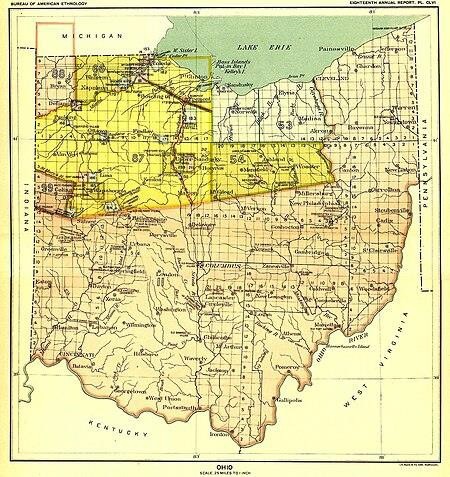
    Just ten years after the Greenville Treaty, the promises to Native people were reversed by the United States government, who had first made the promise. In 1805 the lines of Indian lands were redrawn with the Treaty of Fort Industry, which took away the lands of the Chippewa, the Delaware (Leni Lenape), the Munsee, the Ottawa, the Potawatomi, the Shawnee, and the Wyandot who signed the treaty under duress. The eastern boundary of Indian lands in northern Ohio was moved from the Tuscarawas River and Cuyahoga River westward to a line 120 miles west of the Pennsylvania boundary.


    The Treaty of Fort Industry signed away the land from Native people and expanded lands for settlers. The land (shown in the map in yellow) became the ‘property’ of the United States government.

    The grandson of an early settler described what is now Green Township as his grandfather recounted the story to him. ‘The Virgin forests were dense and beautiful, dark in aspect and deep beyond measure in magnitude. They were unbroken and interwoven with vines and underbrush. In many places, swamps, underbrush and high-ranking weeds covered the lowlands. Indians and wild animals roamed through the swamps and the dark avenues of the forest. Serpents and reptiles abounded in abundance over the land. The hawk, buzzard, and eagle proclaimed their dominion from the treetops. (History of Smithville by Paul G. Locher)

    The historian Benjamin Douglass wrote specifically about Green Township in his 1878 History of Wayne County. ‘The early inhabitants of this township observed one peculiarity in the first occupancy of it. It was a wilderness, overgrown with timber, with the exception of about twelve acres on the south-west quarter of Section three, which was clear of trees, stumps, and even roots, and was called by the early settlers, ‘the Indian’s Field’. If a twelve-acre field was notable to be mentioned in a local history, it was because of its contrast to the old growth forest that surrounded it. Green Township was not originally a place of sunny grassy meadows.

    Settlers initially saw the forests as a commodity to be harvested. Green Township is said to have had the heaviest and most plentiful timber of any township in the county. Historians noted red, white, and black oak, hickory, chestnut, walnut, maple, beech, ash and elm. Soon, the settlers saw the forests as an obstacle that needed to be overcome. They set about clearing the forests to make farms instead. David Stanley wrote in his personal memoirs:

    ‘The land was considered very thoroughly grubbed when the plough could run 10 feet without meeting a stump or root. The clearing of the land in those days embraced the girdling of the big timber, the grubbing out of all bushes less than 6 inches in diameter, and the cutting down and burning or removing of all saplings up to 10 inches…After the first clearing, the heavy deadened timber remained. Huge dead trees dotted over the fields, their bare bodies and naked limbs in the dusk of the evening, or the pale light of the moon having a most dismal and ghostlike appearance. The removal of this huge crop of dead trees was a giant task. Many of the trees 4 feet or more in diameter were chopped down. (and burned)… All consumed for no more purpose but to get rid of it. It had to be removed to make way for the cornfield. Burning of the heaps was a week’s work.’


    When the white settlers came, many acres of the Great Eastern Hardwood Forest were intentionally removed to make way for farming. The Great Eastern Hardwood Forest was said to be second only to the Amazon rainforest in terms of diversity of species. In the late 1700s, the forest cover in what is now the state of Ohio was estimated at 95 percent. Massive forest clearing for crop production dropped the forest cover to just 10% of the state by 1910. Today, about 30% of Ohio is forested.


    The Arrival of Our People

    Amish Mennonite settlers began moving to what is now Green Township from Somerset County, Pennsylvania to take advantage of this ‘available’ land to which they could now have a clear title. Land could be purchased directly from the United States government with land patents signed by the President of the United States.

    I adapted Wendell Berry’s poem originally written about his home in Kentucky. My changes are in parentheses.

    From (Pennsylvania) they came to wilderness old past knowing, to them new.

    A quiet resided here, into which come these new ones,

    minds full of purpose, loud, small, reductive, prone to disappointment.

    They surveyed their places in it, established possession.

    (‘From the Tuscarawas River and Cuyahoga River westward to a line 120 miles west of the Pennsylvania boundary.’)

    Within that figment geography of random landmarks, the trees were felled. The plows scribed their lasting passages, exposing the ground to the sky.

    The hot sun and hard rain then came down upon it, undeflected by a shadow or a leaf.

    What was there that they so much wanted to change?

    They wanted a farm, not a forest.

    From then to now, no caring thought was given to these slopes ever tending lower.

    Thus nature’s gift, her wealth and ours, is borne downstream, cluttering the bottom lands in passing,

    and finally, is lost at sea.


    As the Amish Mennonite and other settlers came to this land that would be called Green Township, they were surely aware of the presence of the native people who had so recently occupied the land before their arrival. They knew about the twelve-acre cleared field. John Winkler, an early settler in Green Township, remembered that there was an Indian Camp at Crouse’s farm between Paradise and Smithville. He remembered that they were peaceable and frequently returned to visit their old hunting grounds.

    After the Treaty of Fort Industry in 1805, the United States government kept working to intentionally remove the indigenous inhabitants of Ohio. The Wyandot were the last to be removed from the state in 1843 through a series of treaties negotiated on behalf of white settlers. The Shawnee now live in Oklahoma. The Wyandot were removed to Kansas. Some Leni Lenape went to Canada.

    The people were lost. The forests were lost. Some animals, like the formerly abundant passenger pigeons, were lost to extinction. Much soil was lost.


    The Land Where We Live

    John Stutzman, an Amish Mennonite from Somerset County, Pennsylvania arrived on the land where we live in 1814 at age 16. He claimed and purchased 320 acres of Section 10 of Green Township. He received a patent for the land from President James Monroe. According to the Treaty of Fort Industry, when the ownership of the land changed from the US government to John Stutzman, native people were no longer allowed to use the land for hunting.
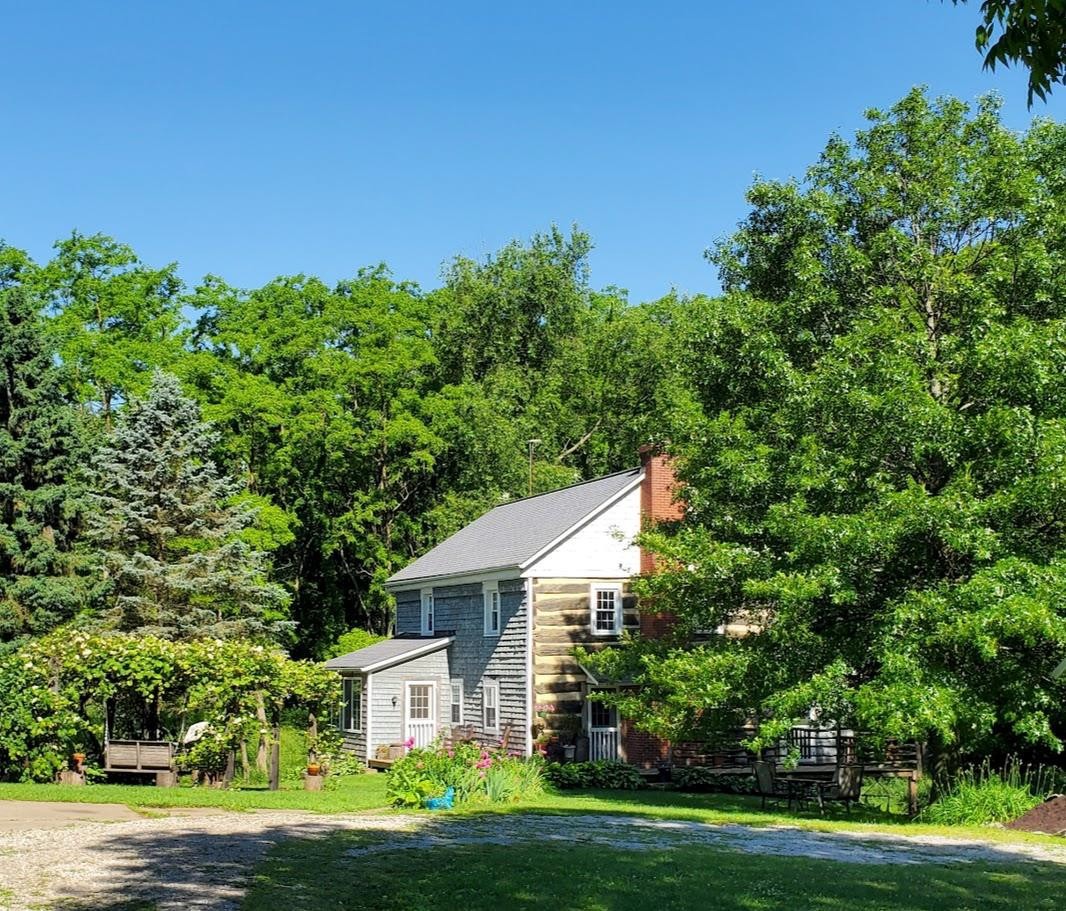
    The 76 acres and the house where we now live was a part of the 320+ acres owned by John and Sarah Stutzman. With all those acres to choose from, John and Sarah Stutzman chose this particular spot for a house, at a time when there were only three other houses anywhere in Section 10. It is beautifully situated among rolling hills and between two springs.

    John and Sarah Stutzman were some of the original members of the Oak Grove Amish Mennonite Church. Because the church did yet have a cemetery, it makes sense that family members who died before 1854 are buried on the farm. There may also be native gravesites.

    John and Sarah Stutzman had 13 children over a period of 22 years. The deaths we are aware of include:

    1829: Infant boy (age 2)
    1833: John Stutzman (age 2) 1834: Freeman Stutzman (infant) 1844: Christina Stutzman (age 1)
    1845: Anna Stutzman (age 15)
    1854: Lydia (Harmon) Stutzman (age 24 of typhoid)
    1854: John Stutzman (age 52 in the same typhoid epidemic)

    We assume that all these people are buried on the land. A registered cemetery in the northeast corner of the land has just one remaining marker for Lydia (Harmon) Stutzman, wife of David B. Stutzman and daughter-in-law to John and Sarah. She died in a typhoid epidemic on August 15, 1854, aged 22 years, 10 months, and three days.

    Sarah (Blough) Stutzman, John’s widow, died much later at the age of 78. She was buried in 1880 in at Oak Grove Mennonite Church, which had a cemetery by that time.

    A Stutzman descendent sold this land to William Crites sometime before 1908. My grandparents, Aldine and Velma (Steiner) Zimmerly bought the eighty-acre farm from Emanuel Crites in 1932. My grandma’s family were Amish Mennonite settlers and my grandpa’s family were Swiss Mennonite settlers who both came from settler farms within two miles of this land. With generational connections to this land, the Stutzman family, the Crites family, and the Zimmerly family are the only families to have lived on the land since 1814.

    My grandparents loved this land and struggled to keep it during difficult times, especially during my Grandma’s serious illness. My Grandpa Aldine sold the farm to my Grandma, Velma, in 1950 for $1. In 1960, my dad, Glenn, wrote home from Indonesia (where they were serving with MCC) ‘If you are having difficulties with the money end of it, Martha and I can at least help with several hundred dollars. Just write and tell us and we can have it sent from the bank at Wooster. Oh yes, don’t sell the farm!’

    Aldine and Velma took out a mortgage on the farm in 1963. My grandparents sold the farm to my parents, Glenn and Martha, in 1966 for $1. Glenn and Martha took out another mortgage in 1966. Both my grandpa and my dad worked in other jobs to be able to keep the land. My parents eventually expanded their acreage by purchasing the farm of my great grandparents, Jacob and Anna Zimmerly and another acreage both in Section 14 of Green Township.

    The farm was finally paid off with an inheritance from my maternal grandfather in the late 1990s. In 1998, my parents gathered their two children and their families to discuss the future of the land.

    They wanted to do an agricultural easement or to donate the land for mission. They eventually decided to keep the land to allow my brother’s family and our family to continue to serve and volunteer in ways that would not guarantee a retirement income.

    After the death of my mother in 2002 and my dad in 2006, my brother’s family and our family inherited the land. We sold off the other two farms so that my brother could purchase a farm in Ontario. We eventually returned to the home farm in 2017.


    Donating a Conservation Easement

    Our family has deeply loved and cared for this land for generations. In some ways, we depend on the land as our retirement plan. Yet the land is stolen land. Because of our experiences, we no longer think of the land as a commodity or refer to it as a ‘property.’ The land is the land. We live on it and have a responsibility for it.

    Joy Harjo, the 23rd Poet Laureate of the United States, a member of the Mvskoke (Muscogee Creek) Nation, writes

    Bless us, these lands, said the rememberer.

    These lands aren’t our lands. These lands aren’t your lands.

    We are this land.

    Tarhe the Crane, a Wyandot chief, eventually signed the Greenville Treaty in 1795. Still, he believed that no one owned the land and no one had the right to sell it out from under anyone. Tarhe explained his understanding of the land to Anthony Wayne, the military general who had ‘won’ the land.

    It belongs in common to us all. No earthly being has an exclusive right to it. The Great Spirit above is the only true and right owner of the soil; and he has given us an equal right to it.’ (Mary Stockwell, The Other Trail of Tears: The Removal of Ohio Indians; Westholme, 2016)


    This echoes our own Anabaptist faith tradition. David the psalmist declares in Psalm 24: ‘The earth is the Lord’s and everything in it, the world and its inhabitants too.’

    Our son, Ben, proclaimed this when we visited Ohio from Congo on a home leave when he was three. We had been living in a village in what is now DR Congo on traditional lands, held communally. In Ohio, Ben asked to walk across my uncle’s fields to a woods that he could see in the distance. When we explained that he didn’t have permission because those woods belonged to someone else, he became indignant and confused. ‘How can those woods belong to someone? They belong to God!’

    Author Wendell Berry reflects the settler paradigm of property/title, but still sees the land as a gift and our responsibility to be the land’s caretakers. He writes,

    ‘The ecological teaching of the Bible is simply inescapable. God made the world because He wanted it made. He thinks the world is good and He loves it. It is His world. He has never relinquished title to it. And He has never revoked the conditions bearing on his gift to us of the use of it, that oblige us to take excellent care of it.’


    Over the years, my parents, Glenn and Martha Zimmerly, cared for the land in the best way they knew as an expression of their faith. We inherited my dad’s copy of the book, Earthkeepers by his friends, Art and Jocele Meyer, with chapter titles of ‘New Testament Environmental Ethic’ and ‘Ecojustice: a Theology of Ecology.’ My dad taught vocational agriculture and was an early adopter of conservation practices including contour farming, no-till planting, grass waterways, afforestation of a ravine and a wildlife pond built with government conservation assistance.

    <
  • In Awe of God’s Creation: Mennonite Men Visits Oregon

    In Awe of God’s Creation: Mennonite Men Visits Oregon


    Back in March of 2025, I took Amtrak to visit parts of Western Oregon as a Mennonite Men representative. I wanted to build connection and witness what God is up to in the Pacific Northwest. One of the unifying experiences of the Northwest: trees! The train took me through Glacier National Park where snow still covered the trees before arriving to the hazelnut groves, Douglas fir, Oregon white oak, and cherry trees of the Willamette Valley.
    In advance of the trip, I made contact with the conference minister of Pacific Northwest Mennonite Conference, several area pastors, and some friends and others I knew personally. One of my known destinations from the outset was to visit Salem, Oregon and catch up with folks at Zena Forest Products, an inspiring company that practices sustainable forestry while making beautiful wood products. Mennonite Men’s JoinTrees program has awarded Zena and the Deumling family for their planting of Oregon white oak, a tree species that’s so important to forest health and ecosystems of the Northwest but has long been neglected or choked out in part by the overplanting of conifers. Though slow growing, Oregon white oak is stunning in its glory, its mature white oak trees often covered in moss and lichen.

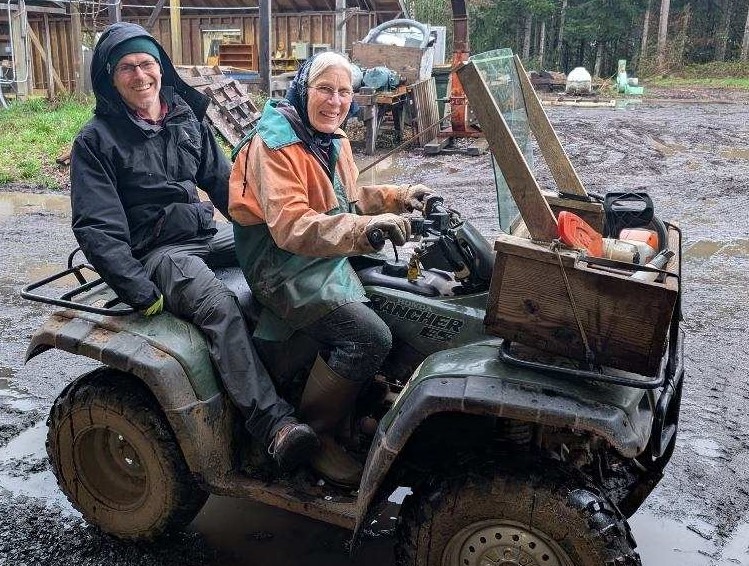
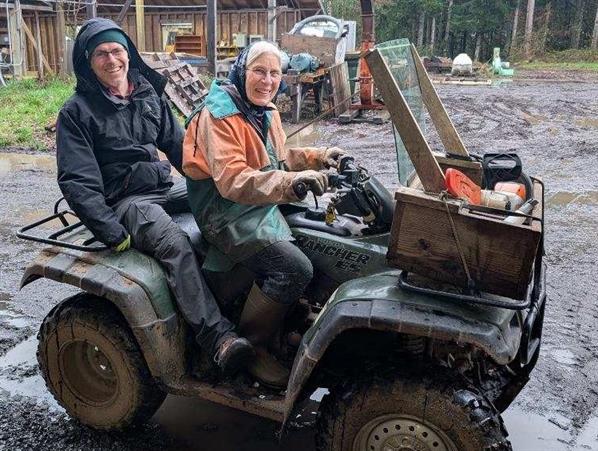
    Right: Jon Zirkle, author and Mennonite Men co-Coordinator, with Sarah Deumling

    The site visit to Zena Forest Products began early in the morning, and rain did not stop me from a complete tour. I was fortunate to see the woodshop, witness the sustainable practices used in the milling, meet founding family members Sarah and Ben Deumling, and ride on the 4-wheeler through the woods and hills with Sarah to see the young Oregon white oaks planted with support from JoinTrees. I enjoyed seeing the flooring products and wooden floor vents that Zena has become well-known for producing from sustainably grown and selectively harvested trees. Staff members were proud to inform me that their signature Zena EdgeGrain™ Oregon White Oak Flooring is installed at Portland International Airport and helps to educate many folks visiting the region about sustainable forestry and native trees.

    Sarah and Ben Deumling are visionaries. Every step of their process as a company prioritizes future generations and ecological care. In fact, Sarah has presented about Zena at Oregon State’s school of forestry to share the exceptional model of sustainable forestry and ecological restoration that Zena exhibits. After Sarah’s tour of the Oregon white oak plantings, it was abundantly clear how much her faith and vision informs how she approaches her life and the company. We talked about faith, books, Sunday school teachings, our fondness for trees, and land stewardship as well as our families, hopes and dreams and the planet’s wellness.

    I took Amtrak to Oregon not only to reduce my environmental impacts from travel, but also for the chance to arrive more slowly and see the scenery en route to Portland. The rest of the trip in Oregon only worked because of public transit, a borrowed car, and generous hospitality by folks at Portland Mennonite, Salem Mennonite, Zion Mennonite, Albany Mennonite, Drift Creek, and more. Thanks to Tony Kauffman and Chris Nord of Drift Creek (Executive Director and Board Chair respectively), I visited the raw Oregon coast and the towering trees of Drift Creek after enjoying profound conversations in the car. I met tree planter and Earth steward Joe Blowers of Portland Mennonite and learned about PMC’s men’s group, visited pastor Kristen Swartley and Luis Tapia Rubio’s new baby, and shared a meal with pastor Steve Bomar of Zion Mennonite. And I worshipped at Albany Mennonite, enjoying their coffee hour and seeing trees they planted onsite.

    Through visiting congregations, sharing about Mennonite men, and experiencing the land of the Northwest, I had the chance to appreciate the Earth, God’s first gift, and to feel what it’s like to be out on the edge of this continent, away from the Mennonite centers in the East and Midwest though surrounded by stunning and wild examples of God’s creation.

    I am deeply thankful for the many folks I met and was inspired by, for the majestic wild Oregon forests and coast, and the dedication to tree planting and native habitat restoration I witnessed firsthand. May the trees planted with help from JoinTrees continue to flourish and give life, and may the stories of God’s creation continue to inspire and offer hope.


  • Join the Conversation: Help Us Explore Anabaptist Rites of Passage for Boys

    Join the Conversation: Help Us Explore Anabaptist Rites of Passage for Boys


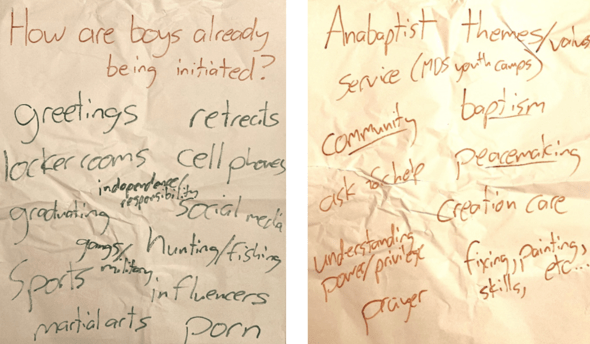
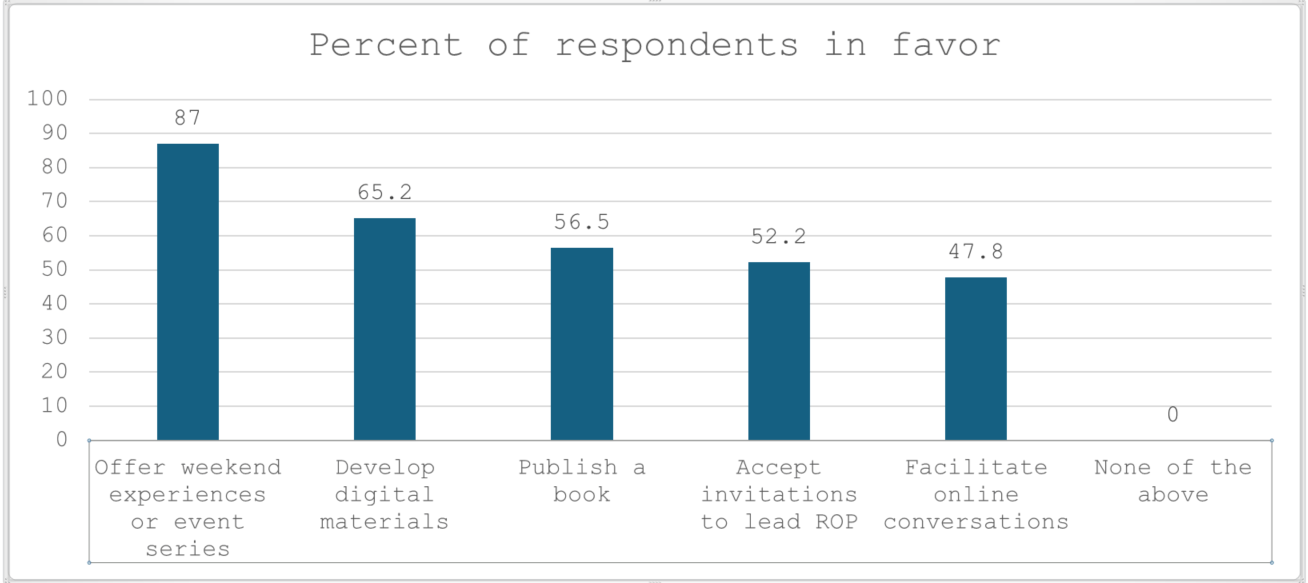
    Mennonite Men is gathering information on rites of passage for boys from an Anabaptist perspective. We want to explore the ways that Mennonites have or want to honor boys coming of age in meaningful ways. This could be through the giving of gifts, creating ceremonies, organizing special trips, words of blessing and more. Mennonite Men recognizes that this topic is of interest for a wide range of parents, families, and boys, and that there is not a goal of a singular approach to offering rites of passage that works for everyone. In particular what might be unique about an Anabaptist approach? Perhaps you have ideas.

    This growing interest in rites of passage for boys has led the JoinMen committee and the full board of Mennonite Men to discuss and create an online survey about boys rites of passage. Below is a link to this online survey. We hope many will participate in the survey. The more responses we get the better. Anyone is welcome to fill out the survey, and we also hope that many men will complete the survey.

    Find the survey here

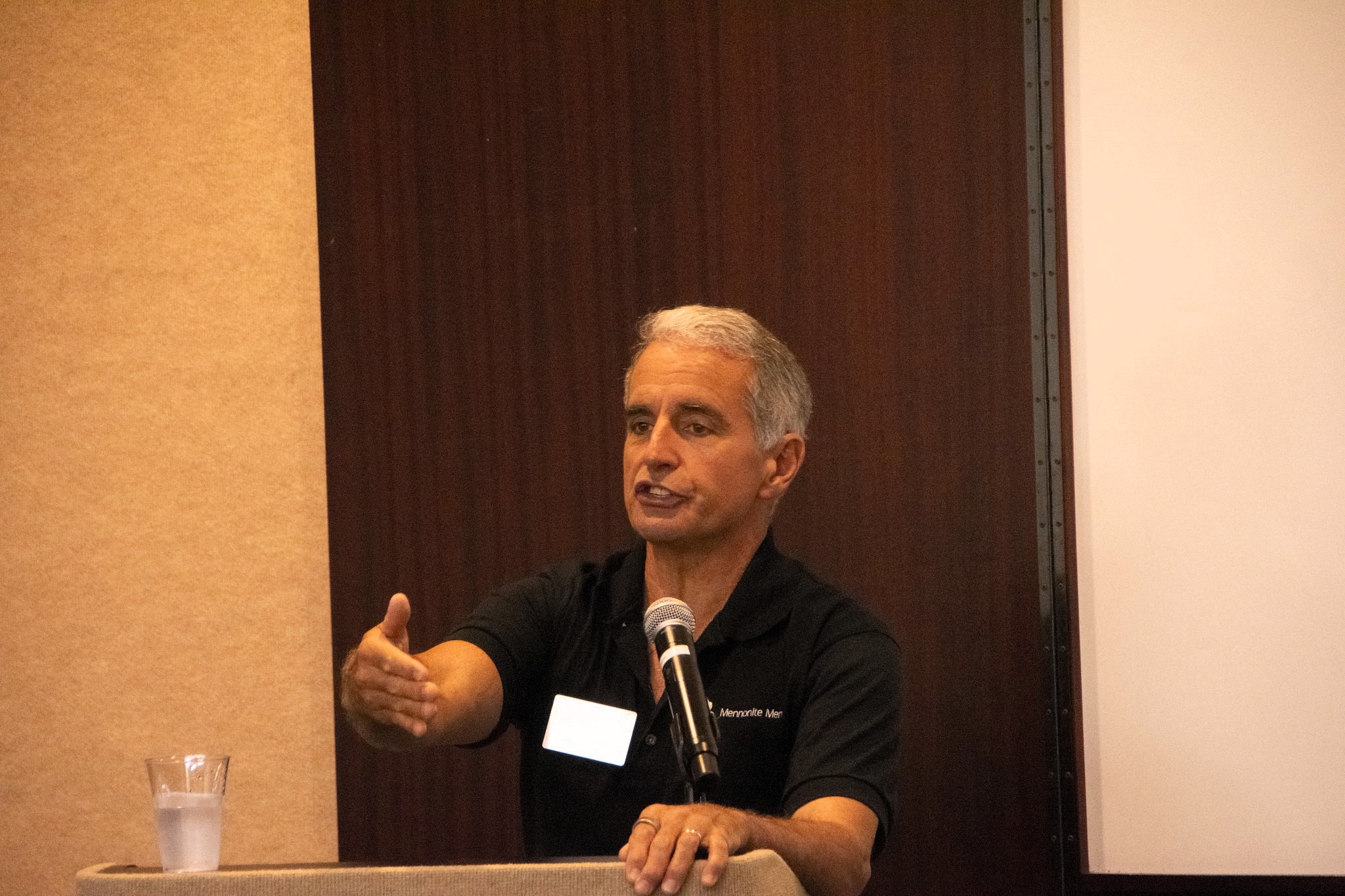
    Jon Zirkle, Co-Director of Mennonite Men


  • Why Oak Flat Matters: A Mennonite Reflection on Sacred Land

    Why Oak Flat Matters: A Mennonite Reflection on Sacred Land

    In February I spent a week doing prayerful accompaniment at Oak Flat (Chi’Chil Bildagoteel) in Arizona, sacred land of the Western Apache. Sarah Augustine and the Coalition to Dismantle the Doctrine of Discovery encouraged Mennonite Men to pursue training to accompany Apache Stronghold as they advocate for the protection of Oak Flat and their religious freedom. I did the training and have served on the accompaniment team. This February I joined a Mennnonite teammate at Oak Flat for daily prayer walks, camping on the land, communicating with and supporting Apache Stronghold, and experiencing God’s creation firsthand.

    Each time I’ve gone to Oak Flat has been transformative. For a Midwesterner it has taken multiple days, multiple visits, and learning from the Apaches to get acclimated and begin to realize just how full of life this sacred land truly is. Even without verbal explanations, simply being at Oak Flat inspires gratitude, reverence, and prayer. That said, if Apache Stronghold had not shared history and background with me, I would not even begin to understand the depth of its sacredness.

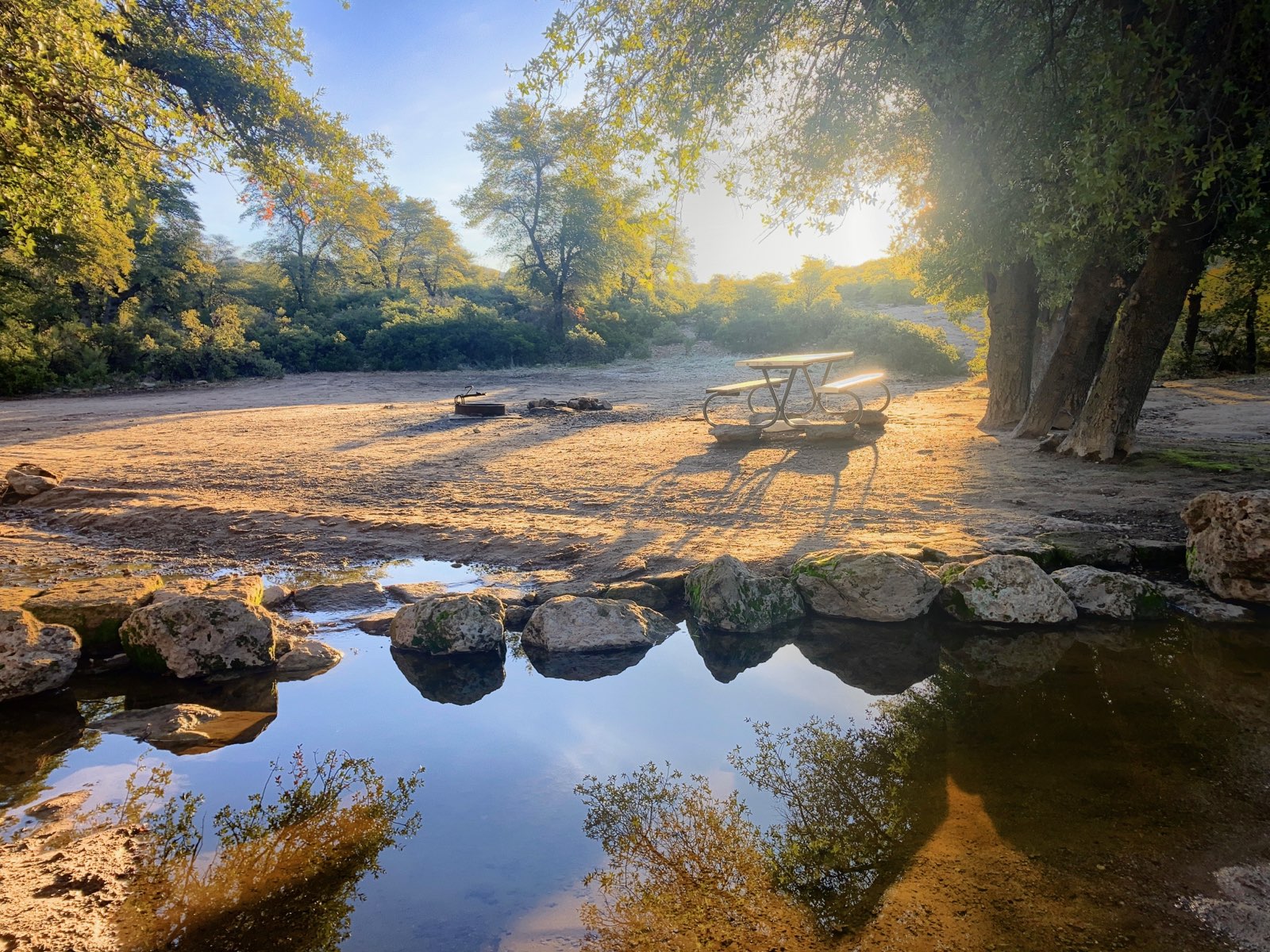
    Photo: campsite occupied by the author and other allies from The Coalition to Dismantle the Doctrine of Discovery. Photo credit: Tim Nafziger

    As a white male settler and a visitor, no one owes it to me to teach me all the facts, history, and symbolism of this place. I have been taught enough and have personally experienced enough to have my heart swell with love for God’s creation as experienced here. My heart breaks at the thought of this land being transferred to a foreign mining company, knowing this land would collapse into a crater and Apaches would be cut off from coming here. Oak Flat is considered by Apaches to be a female mountain, a source of water, food, medicine, shade, a home to many creatures and to angels. Ancestral remains are buried in this land. Ancient petroglyphs carved on canyon walls are still visible. Important ceremonies and prayers take place here, ceremonies where Apache creation stories are reenacted. Boys and girls come here for coming of age rituals to be oriented and welcomed into adulthood and more fully into their community. This is a place of storytelling, family reunions. If Chi’Chil Bildagoteel is destroyed, Apache religious practice is destroyed forever.

    Oak Flat contains low spots where water sometimes collects, allowing large Emory Oak trees to grow. Some of the tree trunks are three and four feet in diameter. Curved and wide-spreading branches hang low, inviting people and birds and other creatures to find respite in their shade. These trees are sometimes referred to as ‘grandmother oaks’ and said to be between 300 and 600 years old. I imagine the bumps, curves, and scars on their trunks have many stories to tell. In the summer these giant oaks produce acorns gathered by Apaches as a food source. I have had the pleasure of being offered delicious acorn soup made from acorns collected at Oak Flat. These abundant acorns not only feed people, they also feed acorn woodpeckers, orioles, jays, and javelina. I have thoroughly enjoyed seeing hawks, ravens, towhees, cardinals, finches, hummingbirds, and small lizards rest in their branches.

    Settlers like me may not have trees nearby that were alive for hundreds of years, providing food to feed our community. We likely don’t have trees under which our people gathered for dance, prayer, family reunions, and birthdays for hundreds of years. And, I would wager, we likely don’t have trees that our people intentionally let grow for hundreds of years without cutting down for lumber. We likely don’t fully understand the gratitude held by indigenous peoples, don’t regularly thank God for trees that give us food, shade, shelter, and home to birds. Our Apache sisters and brothers do.

    What if we Anabaptist Christians learned to view trees with a kind of reverence and kinship that led to protecting them, letting them live to old age? What might we learn about God by caring for oak trees, fine examples of God’s creation? Have we pondered the importance of trees named in the Bible?

    Join me, join Mennonite Men, join Apache Stronghold as together we consider the love of God the Creator shown by creation. May we learn that places, mountains, trees, people, places of flowing waters have meaning and significance beyond their utility, that God’s special places can’t be destroyed and simply recreated elsewhere.

    I hope we as Christians learn and tell stories about trees, find shelter under trees as a place to pray to God, and inspire children to enjoy trees.

    Join Mennonite Men in remembering Oak Flat. Pray for Oak Flat, its Apache defenders, and for the Supreme Court justices who are considering whether to hear the case of Apache Stronghold.


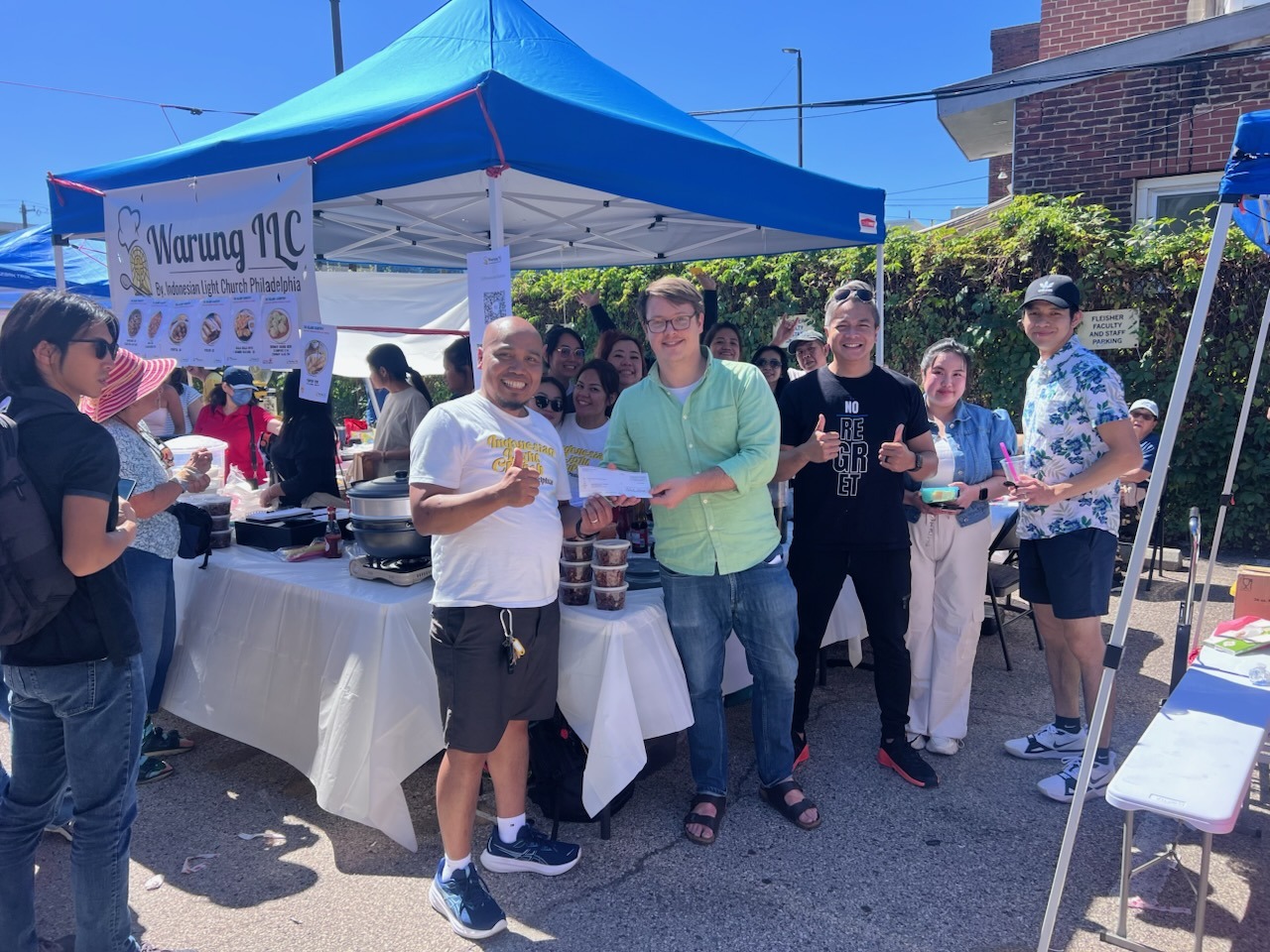
  • Mennonite Men Awards $40,000 JoinHands Grant to Indonesian Light Church for Building Purchase

    Mennonite Men Awards $40,000 JoinHands Grant to Indonesian Light Church for Building Purchase

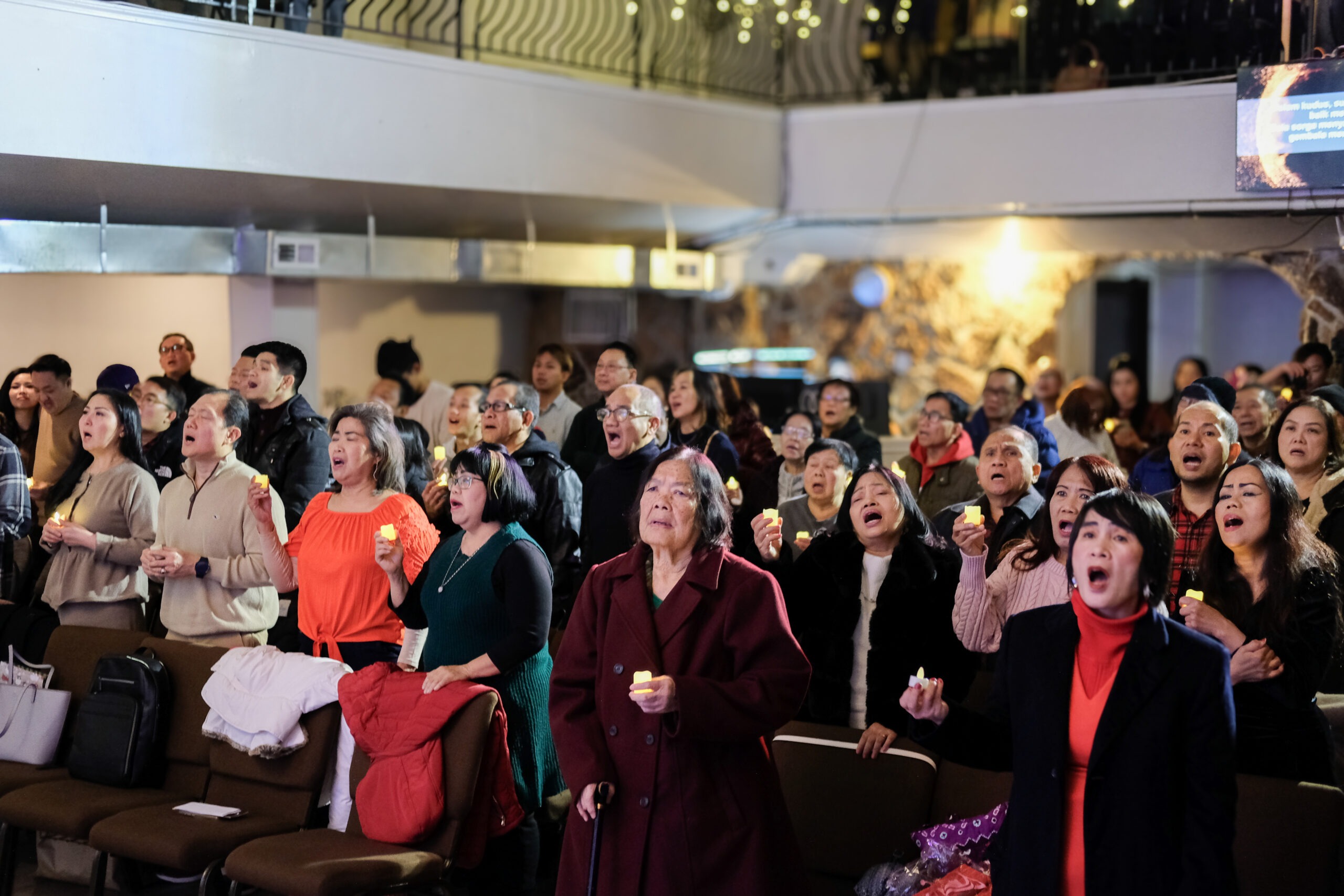
    The Mennonite Men Board has approved a $40,000 grant through the JoinHands program to support Indonesian Light Church of Mosaic Mennonite Conference in purchasing the building they currently occupy. This grant will help the church secure a permanent home for its growing congregation, allowing them to continue serving their community and expanding their outreach to new immigrants in the area.

    Steve Kriss, Executive Conference Minister of Mosaic Mennonite Conference, expressed deep gratitude for the spirit of generosity that has fueled several grants to the Conference. He highlighted the significant role that Eastern District played in investing in Mennonite Men’s JoinHands initiative, which has helped fund projects across the nation.

    Indonesian Light Church, with a membership of 100, serves a vibrant and growing immigrant community in Philadelphia, PA.

    Philadelphia is a hub for new immigrants from around the world, including Indonesia, where many come seeking refuge from political unrest and religious persecution, especially those of Christian faith. The church has become an essential resource for these new arrivals, offering a place of worship, support, and fellowship. The need for a permanent space has become even more urgent as Indonesian Light Church continues to grow, with new members joining almost every week.

    The opportunity to purchase the building they currently occupy came as a rare blessing—a chance to secure a well-maintained property that will serve as a long-term home for their ministry. ‘We decided to buy this church building because it was a rare opportunity to secure a good property that was in great shape,’ said a church representative. ‘This will allow us to continue serving our expanding community.’

    ‘We are deeply grateful to Mennonite Men for awarding Indonesian Light Church the JoinHands Grant of $40,000 to help us purchase our first church building,’ said Hendy Matahelemual, pastor of Indonesian Light. ‘As an immigrant community in the U.S., a church building is more than just a place of worship—it is a safe space for gathering, a community hub, and a home where we can grow together in faith and fellowship. This support means the world to us, and we are forever thankful for this incredible blessing.’

    With the $40,000 grant from Mennonite Men, Indonesian Light Church is one step closer to securing their future and continuing their mission of faith, fellowship, and support for immigrants in Philadelphia. The congregation looks forward to the next chapter of their journey and the continued partnerships that will help sustain their ministry.

    For more information about the JoinHands program or Mennonite Men, or to contribute to to future JoinHands grants, please visit MennoniteMen.org/JoinHands.


  • Finding Connection: Young Men, Faith, and Community

    Finding Connection: Young Men, Faith, and Community

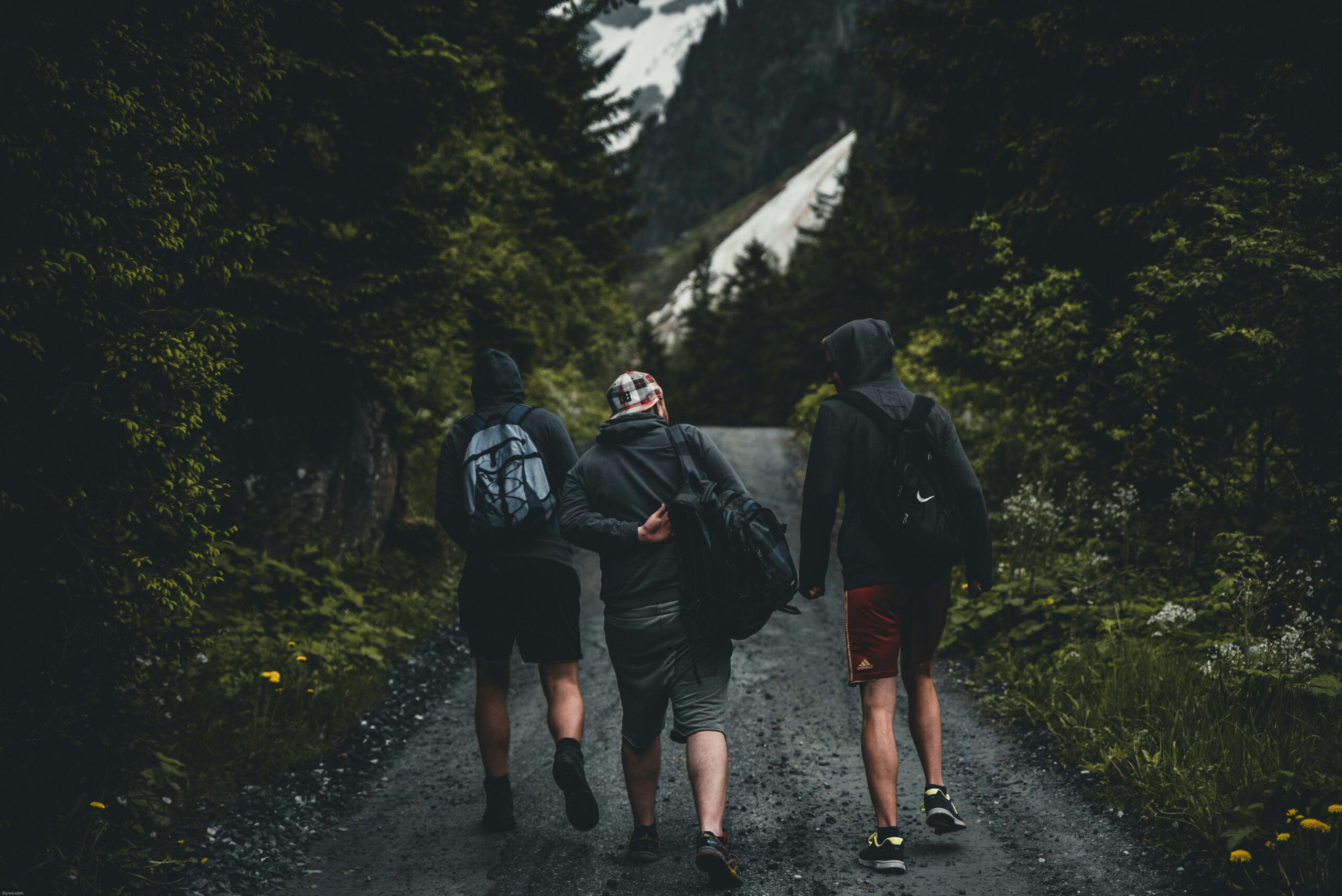
    ​Recently, I went on a walk with several men in their 30s who had attended a Mennonite Men’s retreat I helped lead in November 2024. They had arranged the meetup themselves via group text, eager to reconnect and continue building community. We walked and talked for nearly an hour, engaging in deep conversation.

    I’m excited to see these men taking the initiative to foster meaningful friendships. Many younger men today lack in-person interaction, and some struggle to form friendships at all. This challenge isn’t exclusive to men—I’ve spoken with many young adults, both male and female, who find it difficult to make and sustain friendships.

    These kinds of gatherings may seem surprising, given the stereotype that men avoid personal conversations. Similarly, concerns are often voiced—especially by older Mennonites—about young people disengaging from the church. While I understand their concerns, I also have questions. Are we, as a church, inviting young men into conversations that feel relevant? What topics foster connection and trust across generations?

    During our walk, one participant biked slowly alongside us. As we strolled through the woods and past calming waters, we checked in on each other’s lives. The biker, who was single, shared his experiences with online dating, sparking a lively discussion. Several men spoke about their own experiences, comparing dating apps, discussing their pros and cons, and offering advice.

    I admitted that I had never used online dating—a statement that made me feel like an outlier among Millennials. Still, participating in the conversation was insightful. Online dating is a reality for many Mennonite men, young and old. I even know Mennonites in their 80s who have found it helpful.

    What I observed in this conversation—and in the retreat itself—is that men want connection. They want to talk, exchange ideas, and build relationships. Young men are no exception. If we long for more connection within our congregations, have we fully considered our settings, formats, and discussion topics? What feels relatable and safe to younger generations may seem unfamiliar or even intimidating to older ones, and vice versa.

    By creating intentional spaces for young adults to share their experiences, we foster mutual trust, friendship, and faith formation. Perhaps we might even see greater young adult participation in Mennonite congregations. With a spirit of care and curiosity, faith communities can engage meaningfully with today’s realities—perhaps even discussing topics like online dating in small groups and sermons. In doing so, we live out our faith in ways that resonate across generations.


  • Faith and Forestry in the Central Hardwoods Region

    Faith and Forestry in the Central Hardwoods Region

    ​Growing up I had been provided opportunities to play and work outdoors in forested settings. Whether the oak-hickory forests of southern Michigan where my parents owned a cottage, or the forested slopes of the Four Corners Region of the Southwest where my family resided several times during my adolescent years. The latter experiences shaped my intention to pursue a professional forestry degree in the west and then work for public land agencies in the Rocky Mountain region.

    During my undergraduate studies I worked for a federal land agency during weekends and summers as a temporary employee. The working experiences I had, while valuable, caused me to reassess by life goals and how my Mennonite Anabaptist values might play a role. As a result, I took a two-year break prior to my senior year to explore ways I might serve the church within the context of my future professional endeavors. This led me to working with Amigo Centre, a Mennonite-affiliated camp in southern Michigan, as their land manager. During this break from undergraduate studies in the late-1970’s, I had the opportunity to begin planting trees on a tract of land my family had acquired at the north end of Goshen, Indiana. Forty years later this tract became part of the Pathways Retreat. (Image right: 60-year-old white pine planting- Amigo Centre)

    From these early experiences emerged my life mission: ‘To show persons their integral relationship with the building of God’s kingdom and the dynamics of His Creation’. I pursued this mission by directing my vocation as a professional forester toward working with private landowners— both individuals and Mennonite organization-owned properties. This has included a forty-eight-year relationship with Amigo Centre stewarding their land—including a sixty-year-old white pine planting and, more recently, using forestry practices to rehabilitate their native oak-hickory forestland severely-damaged from a recent straight-line windstorm.

    I also had the privilege of providing forest resources education to adult audiences as a Michigan State University Extension forester, and to young adults as a Goshen College environmental sciences faculty member and Director of Land Management at its Merry Lea Environmental Learning Center. Now recently retired from Goshen College, I continue to stay active in pursing my life mission by doing consulting work with private landowners and Mennonite-affiliated groups that own land.


    As I reflect back on almost fifty years, I am grateful to witness the Mennonite Church more fully responding to ‘the Holy Spirit beckoning us toward the restoration of all things in Christ’. There are many emerging expressions of creation care by individuals and organizations within the broader church—much of which has been led by the younger generations. While we might struggle to differentiate between what is the work that is ours to do and what is the work that is God’s to do, I have great hope for the future. I have witnessed this hope when engaging with private landowners, college students and camp staff, and supporting initiatives such as Mennonite Men’s JoinTrees. More recently I was gratified to connect Camp Friedenswald, a Mennonite-affiliated camp in southern Michigan, to JoinTrees resources for the afforestation of 13 acres of cropland. (Image left: Adventitious sprout- Dominican Republic)

    So, in my experience, what has ‘hope’ looked like? During my graduate studies I spent time in the Dominican Republic (DR). As with many developing economies, native forest cover was being exploited for its wood to make charcoal for cooking. Mennonite Men’s JoinTrees campaign has been active in countries such as this to reforest degraded lands and support community agroforestry efforts. In the DR I captured an image that represented the ‘hope’ that can be found in the resiliency of nature—vegetative shoots on a tree that had been cut for charcoal production. These shoots developed from adventitious buds. They remind me of the hope found in the scripture commonly read during Advent…. Then a shoot will spring up from the stump of Jesse, and a Branch from his roots will bear fruit (Isaiah 11:1).


  • Living that Matters in Retirement – Cancelled

    Come and experience a company of brothers seeking a meaningful life that matters in retirement.

    Location: The Hermitage
    11321 Dutch Settlement Rd, Three Rivers, MI 49093

    Date: 5:00 Friday – 4:30 Saturday, October 18-19

    Cost: Suggested donation range of $120-150. (Includes room, meals, and Living that Matters: Honest Conversations for Men of Faith)

    Registration: see form below. Register by September 15. Limited to the first 12 registrations with a $50 deposit.

    Flyer: download and print or share the digital flyer HERE


  • Mennonite Men welcomes Jon Zirkle to co-leadership role

    Jon brings a background in agriculture, land conservation, not-for-profit leadership, environmental education, and theological training. Jon is a member of Assembly Mennonite Church in Goshen where he helped form a men’s group. He has an MA in Plant and Soil Science from University of Vermont and is a recent graduate of Anabaptist Mennonite Biblical Seminary with a M.A. in Christian Formation.

    Jon will primarily focus on the JoinMen ministry for men and JoinHands grantmaking for new churches while Steve’s focus will remain on development and the JoinTrees campaign for climate action. Jon will also coordinate growing involvement with Indigenous justice in partnership with the Coalition to Dismantle the Doctrine of Discovery.

    ‘I’m excited to work together with Jon,’ says Steve. ‘He is passionate about integrating spiritual formation, social justice, and creation care with men. With his gifts and experience, Jon will provide strong leadership for our mission to engage men to grow, give, and serve as followers of Jesus for God’s shalom.’

    The job-sharing arrangement was first prompted by Steve’s cancer diagnosis and successful treatment. Of Jon’s co-leadership, Steve believes that, ‘as a younger man Jon will help us navigate the next stage of Mennonite Men’s ministry in MC USA.’

    In addition to working with Mennonite Men, Jon directs Bushelcraft Farm, an educational farm in Elkhart, IN he co-founded in 2020, and has worked for the land trust Wood-Land-Lakes that protects Indiana land from development. Jon notes that his ‘small-scale agriculture and environmental work gives [him] perspective on ways that [he has] seen men find meaningful contributions beyond themselves and find connection to the Earth—God’s creation.’

    Jon is attracted to the holistic nature of Mennonite Men’s intent to be refreshing and challenging by engaging men with a focus on the ways of Jesus. ‘Men who are Mennonite need spiritual support and community with other men,’ he shared. ‘I too was missing deeper community and spiritual support. Mennonite Men truly is helping men grow. It’s an organization promoting healthy, faith-motivated men who are ready to listen, serve, tend to their inner life and outer lives, and walk alongside others seeking justice in the world.’

    Jon brings a vision of reaching younger men with diverse backgrounds and life experiences who are seeking community, friendship, and encouragement to deepen their spiritual lives.

    ‘Many of us men have not felt we have permission or much reason to truly know ourselves—our personality type, our source of pain, our desires, our identities as God’s Beloved,’ shares Jon. ‘This is essential work to invest time in, and needs to happen simultaneously with ‘outer work.’ Integrating prayer, community, and gratitude to God into our work is important, life-giving, and also challenging. I look forward to supporting fellow men in the journey of slowing down, identifying their core wounds, releasing control to God, prioritizing relationships, and seeking community.’

    In his work with JoinMen, he will develop new ways to connect with men through retreats, exploration of prayer practices, activism and justice work, outdoor experiences, promoting men’s groups and individual spiritual care, and volunteering in the community.

    Jon’s leadership will facilitate Mennonite Men’s growing involvement with Indigenous justice in partnership with the Coalition to Dismantle the Doctrine of Discovery. Of this connection, he says, ‘I am inspired to see Mennonite Men get relationally involved with indigenous communities and their struggles. I think many non-indigenous men could benefit from experiencing the power of worshipping outside, singing and dancing together, rediscovering rites of passage for boys and men, and finding inspiration to approach life with greater reverence, gratitude, prayer, celebration, and commitment to future generations.’

    Jon brings ‘tend the earth gifts’ as well as interests in both the internal and external aspects of faith formation that are a huge asset to Mennonite Men at this stage of its ministry to Mennonite Church USA.