Category: JoinTrees

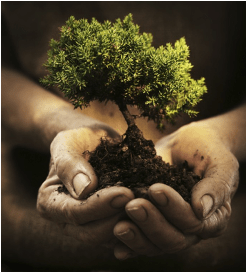
  • Planting trees is a form of Christian stewardship

    Planting trees is a form of Christian stewardship


    The Bible begins and ends by featuring trees of life and reveals the essential place trees inhabit on the earth and their roles, both in the ecosystems of God’s creation and in the lives of its people.


    Jewish teachings carry on this theme. A Jewish midrash, or proverb, states that after God made the first human, God led the human creature around all the trees of the Garden of Eden and said, ‘See My works, how beautiful and praiseworthy they are …Be careful not to spoil or destroy My world – for if you do, there will be nobody after you to repair it.’ Another Jewish teaching says if people claim the world is ending and the Messiah has come, first plant a tree, and then see if the story is true.

    We plant trees because they have environmental, social, and spiritual benefits. Trees capture carbon and slow the warming of the earth. They cool the land and preserve it from erosion, thereby making it a hospitable place for the other beings of God’s creation to live and thrive. The point our eyes heavenward and remind us of the goodness that God proclaimed over all that he had made.


    In a time of ecological crisis that can feel overwhelming, we can find hope and resilience in the simple act of planting trees. The JoinTrees program of Mennonite Men has assisted many communities across the U.S., and Central America take part in this simple act of healing that begins to restore our connection to the land as individuals and as communities. Since September of 2020 when we launched our JoinTrees campaing, 54,920 trees have been planted with funding for another 32,316 approved in March.


    Visit mennonitemen.org/jointrees to read these stories and to join Mennonite Men’s campaign to plant one million trees by 2030.


  • A “Third Way” Forestry Practice in the Zena forest

    A “Third Way” Forestry Practice in the Zena forest


    The upcoming Mennonite Men Eco-excursion will visit and work in the Zena forest in June, 2022. Details about the trip can be found at mennomen.live/oregon.


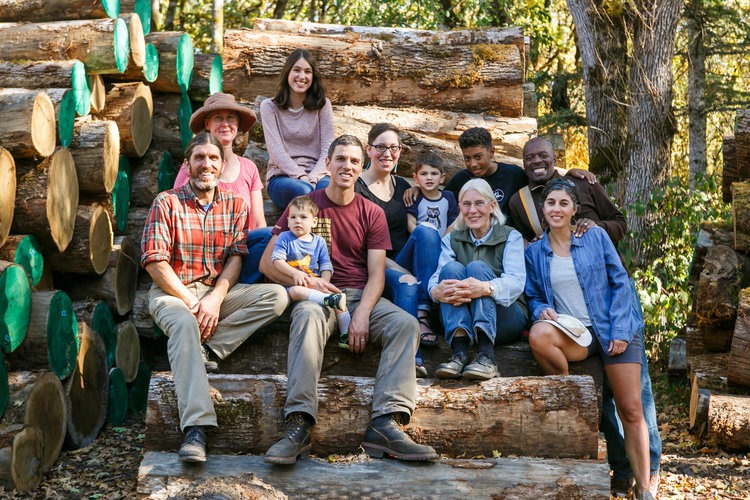
    The story of the Zena forest began in 1984 with the purchase of 400 acres of forestland in Oregon’s Willamette Valley by the German forest owning family for whom my husband Dieter worked. Two years later several hundred acres of adjoining forest land were purchased and in 1987 our family moved back to Oregon, where I had grown up on a family farm, to manage the forestland. We built a house on the edge of the forest which Dieter managed while I managed four children, household, garden, sheep and goats, etc.


    In 1996 Dieter died of cancer and the German owners asked if I would take over the forest management. My other option would have been to go back to teaching high school. Though I had no forestry training the choice was clear – trees don’t talk back and I preferred outdoor to indoor work. I accepted on the condition that they train me which they did with German thoroughness.

    I had my moments of anxiety and doubt as a woman in a largely man’s world which faded quickly when, at some point, I realized that instead of hiding my ignorance I could ASK QUESTIONS. Those loggers and log buyers who spoke another language were only too happy to answer my questions and tell me stories about their work and world.

    Over the years the forest increased in size through the purchase of nearby parcels until it’s zenith of well over 2000 acres. I had grown happily into my job when, in the mid 2000s the Germans decided to sell the Zena Forest which we had come to love and consider home. My first move was to buy 2 lottery tickets, my first and only, to see if God wanted this forest to be ours. It didn’t work. The following two years are a long and complicated story but with angels on my shoulders we won another sort of lottery and since 2008 we have been the owners and stewards of 1300 acres of the forest.

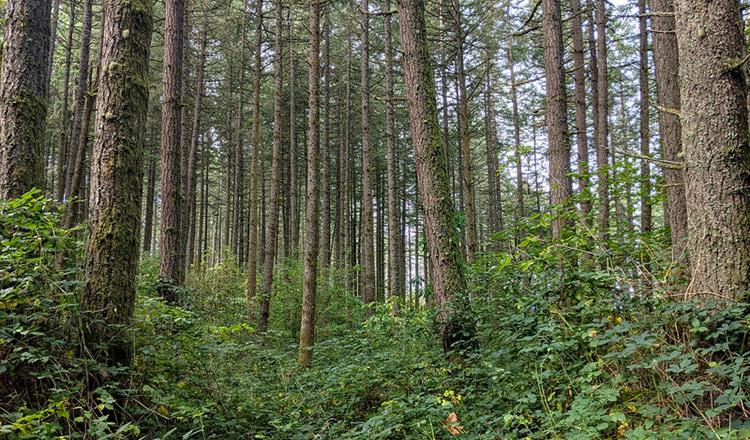
    From the beginning of this story the Zena Forest has been managed in a sort of ‘Third Way’ based on the German ‘Natuergemaesse Waldwirtschaft’ which roughly translates as ‘Near to Nature Forestry’. Our goal is to disturb nature’s natural processes as little as possible, to use the lightest touch possible while recognizing that harvesting some trees carefully can improve the quality and health of the forest ecosystem. Our forest management is an anomaly in Oregon where the industrial clear cut is king, driving our markets, mill capacity and infrastructure. The other end of this spectrum are the environmental groups, with whom we have much sympathy, who often want to cut no trees at all. We have always walked a tightrope between the two.

    The primary differences between Zena management and standard industrial management are:

    1. Valuing all naturally occurring tree species, not just Douglas Fir, and therefore planting a mixture of seedlings most suited to a particular site. Up until our arrival on the scene hardwood trees were considered nuisance trees to be cut and left or, at best, taken to a chip mill. This fact explains our small hardwood mill which has created a market for local hardwoods and a variety of wood products which had not been available from local sources.
    2. Keeping all equipment on designated, permanent skid trails to protect the soil (our capital) from compaction.
    3. Using an ‘individual tree selection’ method of harvesting instead of clear cuts. This often means taking defective trees or competitors of the most vigorous trees.
    4. Leaving logging debris on the forest floor as organic matter rather than piling and burning it after a harvest.
    5. Using machetes instead of chemicals to release tree seedlings from competing vegetation.


    When the industrial types visit our forest they don’t challenge our management but inevitably say, ‘it’s not scalable, it won’t pencil’ which we have, as of yet, been unable to disprove. The Environmental folks tend to listen appreciatively and seem enthusiastically grateful that there might be another way beside the clearcuts.

    A recent essay by a thoughtful farmer in Scotland was entitled ‘How Can I Make a Living Off My Land Without Destroying It?’ Perhaps this is the central dilemma of all conscientious landowners. It certainly is our biggest concern and challenge. I’m still hoping to demonstrate that economy and ecology are one and the same – that an ecologically healthy forest is also the most economically valuable forest. For my grandchildren I want to leave a great deal of love and responsibility for all the wonders of a healthy, vibrant forest ecosystem.


  • Tree planting as Christian discipleship

    Tree planting as Christian discipleship


    The Bible begins and ends by featuring trees of life and reveals the essential place trees inhabit on the earth and their roles, both in the ecosystems of God’s creation and in the spiritual lives of its people.

    Jewish teachings carry on this theme. A Jewish midrash, or proverb, states that after God made the first human, God led the human creature around all the trees of the Garden of Eden and said, ‘See My works, how beautiful and praiseworthy they are …Be careful not to spoil or destroy My world – for if you do, there will be nobody after you to repair it.’ Another Jewish teaching says if people claim the world is ending and the Messiah has come, first plant a tree, and then see if the story is true.

    We plant trees because they have environmental, social, and spiritual benefits. Trees capture carbon and slow the warming of the earth. They cool the land and preserve it from erosion, thereby making it a hospitable place for the other beings of God’s creation to live and thrive. The point our eyes heavenward and remind us of the goodness that God proclaimed over all that he had made.


    In a time of ecological crisis that can feel overwhelming, we can find hope and resilience in the simple act of planting trees. The JoinTrees program of Mennonite Men has assisted many communities across the U.S., and Central America take part in this simple act of healing that begins to restore our connection to the land as individuals and as communities. Visit mennonitemen.org/jointrees to read these stories and to join Mennonite Men’s campaign to plant one million trees by 2030.


  • Defending peace, defending the climate: Anabaptist organizations collaborate on climate change

    Defending peace, defending the climate: Anabaptist organizations collaborate on climate change

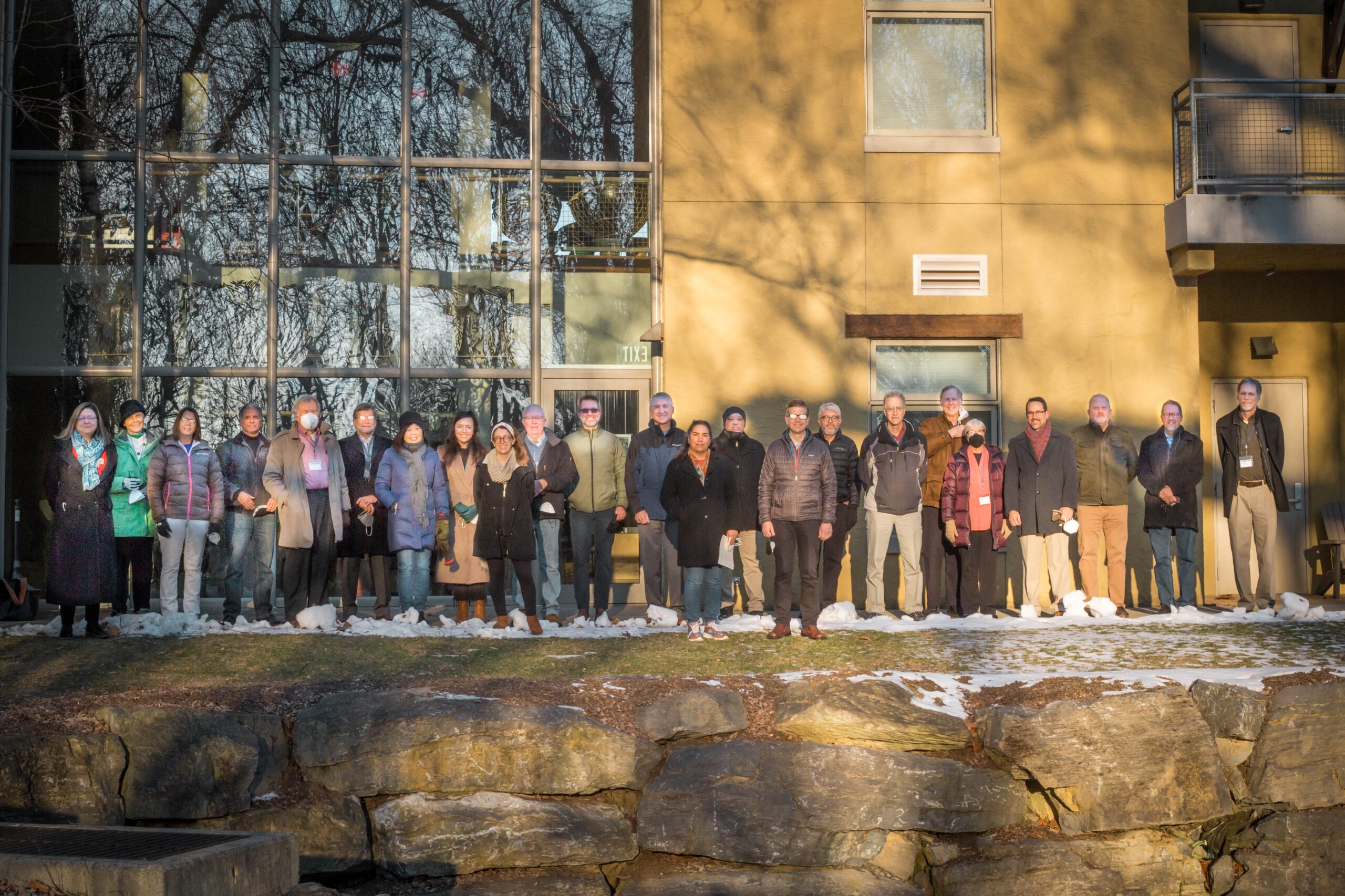
    ​Leadership from 18 Anabaptist organizations in the United States and Canada convened at the Anabaptist Collaboration on Climate Change (ACCC) on Jan. 26 and 27 to address what many consider a moral emergency.
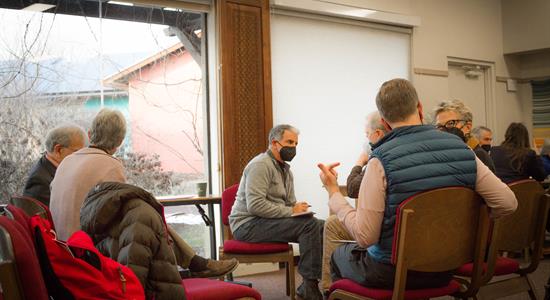

    Those gathered drafted a statement that was later signed by the majority of the participating organizations: ‘As organizations founded on Christian faith in the Anabaptist tradition, we recognize the significant threat to global communities, economic justice, and the next generations from climate change. We are committed to explore our work and mission in support of sustainable and just climate solutions.’ The 24-hour meeting at the Mennonite Central Committee (MCC) Welcoming Place in Akron, Pennsylvania, was the largest gathering of Anabaptist leaders on climate change in North America to date. It was organized by the Center for Sustainable Climate Solutions (CSCS).


    ‘Having so many organizations willing to come together and talk about climate change clearly reflects that this issue is important to Anabaptist communities,’ said Doug Graber Neufeld, director of CSCS, and Professor of Biology at Eastern Mennonite University.

    Since its founding five years ago, CSCS has functioned as a joint initiative between three core partners: Eastern Mennonite University, Mennonite Central Committee and Goshen College. In order to broaden its reach, CSCS is in the process of deepening its relationships with a wider range of partners in programming, governance and financial support. The event was meant to provide a place for a focused conversation on the Anabaptist response to climate change as well as lay groundwork for future collaborations between the organizations. ‘There is a real risk that climate change will have a huge impact on things Mennonites care about,’ Ray Martin, who helped found CSCS, said in an opening speech. ‘Well-being of families, conflict, sustainability of agriculture, hunger, our sense of community, our health, the livability of low-lying areas, even our faith (will be affected).’

    Martin went on to say he believes Anabaptists are uniquely positioned for climate action. Anabaptists have a history of radical innovation, a theology centered around community and care for creation, a background in agriculture and land stewardship and a value placed on simple, selfless living. These are attributes that ‘may make us more open to acknowledging the concerns of global warming and more willing to change our ways to address the risks,’ he said. Jennifer Halteman Schrock, director of Mennonite Creation Care Network which works closely with CSCS on congregational outreach, appreciated the questions posed at the gathering. ‘How might we leverage our unique identity in practical ways? What assets do our organizations have that we could mobilize? What could we do together? It will take time for answers to emerge, but I believe they are the right ones to ask,’ she said.

    Sarah Augustine, a participant who represented the Coalition for Dismantling the Doctrine of Discovery, was inspired by the willingness of the participants to ‘come together and speak with’ one voice’ despite the group’s diversity. Still, there were many voices not present at the table. ‘We represent the people who are causing the problem more than people who are affected by it,’ said Graber Neufeld. ‘We are very aware of that.’ To Augustine, the role of the Coalition at the gathering was to represent those on the front lines of climate change and remind others that climate change isn’t an abstract concept; there are people suffering right now. ‘Indigenous people and vulnerable people… are usually the first people that are impacted; they’re the first that are going to be refugees, the first that are displaced, the first people injured by climate change,’ she said. ‘It’s good to see Mennonite institutions willing to take a stand.’


    Brent Alderfer of Community Energy, Inc., extended this moral concern to future generations, ‘Solutions take more than a tweak to operations—they require revamping our core missions to assure sustainability for generations to come.’ At the ACCC, participants were asked the question, ‘how can CSCS best support Anabaptist organizations in their climate efforts?’ ‘With climate change accelerating, it is clear that individual organizations will find it more and more difficult to make a difference,’ said Mark Lancaster, Advancement Director for CSCS. ‘There is a growing need for building collaborations among Anabaptist organizations to create broader impact, and CSCS would like to embrace this role to coordinate work and catalyze actions.’
    The center plans to organize more gatherings on climate change in the future, and include a broader range of participants. In the meantime, CSCS facilitators encouraged participants to consider how Anabaptist organizations working in diverse areas can incorporate climate justice into their operations and missions. For Mennonite Men, this looks like developing the JoinTrees campaign with the goal of planting a million trees by 2030. For Goshen College climate action looks like developing young leaders and conducting research that will inform the sustainability work of others. For the Mennonite Healthcare Fellowship, it means exploring the ethics and impact of climate change to human health, while for MennoMedia, it looks like incorporating Anabaptist perspectives of climate issues into the publications that reach beyond Anabaptist audiences.

    The gathering left many participants with new questions, but also with newfound hope. ‘Having the Mennonite church step forward as a tradition and say ‘on behalf of peace we have to defend the climate… defend the earth.’ That brings me hope,’ said Augustine. Graber Neufeld concluded his presentation with a reminder: when it comes to climate action, the outcome is what’s most important. ‘In everything, we are not interested in doing things just for the sake of doing things, but because it makes a difference…’ he said. ‘(The) ultimate outcome for us would be climate justice.’


    Organizations that participated in the meeting were CSCS (as the convening organization), Coalition for Dismantling the Doctrine of Discovery, Eastern Mennonite University, Everence Financial, Goshen College, MCC U.S., MCC Canada, MennoMedia, Mennonite Church Canada, Mennonite Church USA, Mennonite Creation Care Network, Mennonite Disaster Service, Mennonite Economic Development Associates, Mennonite Healthcare Fellowship, Mennonite Men, Mennonite Mission Network, Mennonite World Conference, and Merry Lea Environmental Learning Center of Goshen College.

    A link to the consensus statement and signatories is found at the CSCS website for the meeting: https://sustainableclimatesolutions.org/anabaptist-climate-collaboration/


  • Indianapolis congregation transforms lawn to habitat

    In November, 2021, First Mennonite Church in Indianapolis, Indiana, planted 55 trees on church property. Led by the congregation’s Creation Care Crew, the project transformed a piece of the lawn to wildlife habitat that will better capture carbon dioxide, beautify the property, and help reduce standing storm water in the neighborhood.

    Steve Thomas, U.S. coordinator of Mennonite Men and certified arborist, provided some initial guidance on this project. The crew of 28 volunteers planted primarily native trees with the addition of some non-native fruit-bearing trees, the produce of which can be used or shared by congregation members. A portion of the trees planted will line the future path toward a memorial garden, which is the next phase in the congregation’s property update plan.


    To date, over 33,500 trees have been planted through the JoinTrees campaign. To learn more about JoinTrees and how you and your community can get involved, visit mennonitemen.org/jointrees.


  • EMU students help reintroduce American Chestnut in Virginia

    EMU students help reintroduce American Chestnut in Virginia

    In early October, EMU students helped to complete the reintroduction of 200 American Chestnut seedlings on 11 sites in Rockingham County, Virginia. The project, led by Loren Hostetter, a volunteer with the American Chestnut Cooperator’s Foundation (ACCF), has been working to reintroduce the tree to its historical habitat and to educate the public about the dangers of invasive species and the pathogens they carry.

    The American Chestnut once numbered nearly four billion in the eastern United States and southern Ontario. It played an important part of the ecosystem in its natural range and an essential piece of the early U.S. agricultural economy both for its nuts and its rot-resistant, straight-grained, fast-growing wood. In the early 20th century, a deadly blight was introduced from Asia that effectively destroyed the tree’s population in about 40 years.

    Since the 1980s, the American Chestnut Cooperator’s Foundation (ACCF) has been working to crossbreed surviving trees to resist the blight. Their hope is that ongoing trials and partnership with the National Forest Service and Shenandoah National Park will someday see the largescale return of the American Chestnut to wide swaths of its native range.

    The planting was funded in part through a grant from JoinTrees, a campaign of Mennonite Men, the men’s organization of Mennonite Church Canada and Mennonite Church USA, to plant one million trees by the year 2030.

  • Local Congregation brings community together to plant 640 trees

    Local Congregation brings community together to plant 640 trees

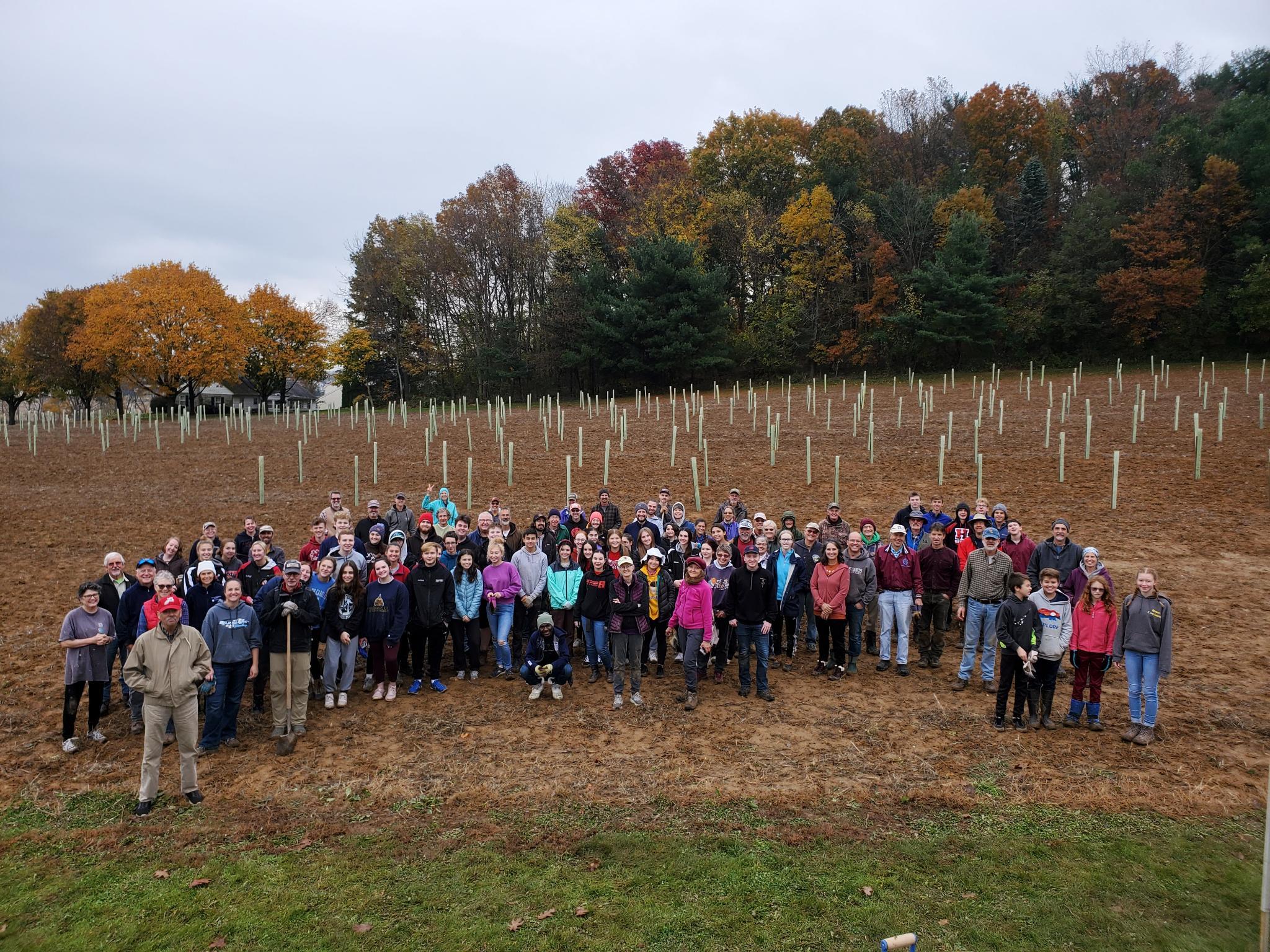
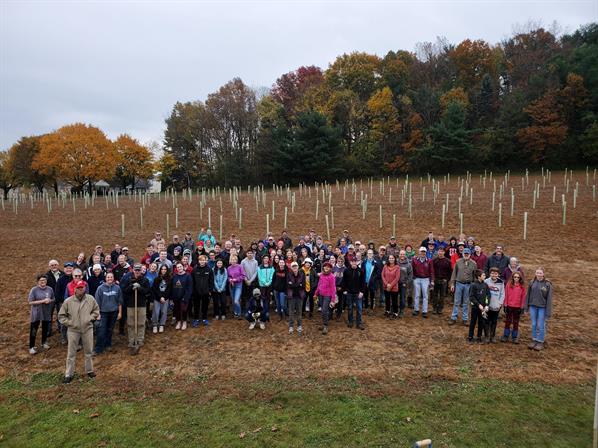
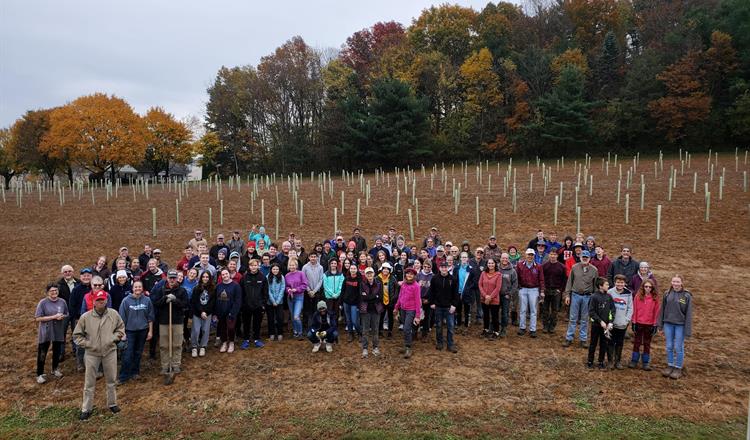
    On two Saturdays in November, volunteers gathered at Landisville Mennonite Church to convert 3.65 acres from farmland into forest and meadow as part of the congregation’s efforts to improve water quality, expand pollinator and wildlife habitat, and address climate change. On November 6, over 80 volunteers planted meadow seed on 1.25 acres, and the following Saturday, November 13, over 100 volunteers planted 640 tree seedlings on 2.4 acres.
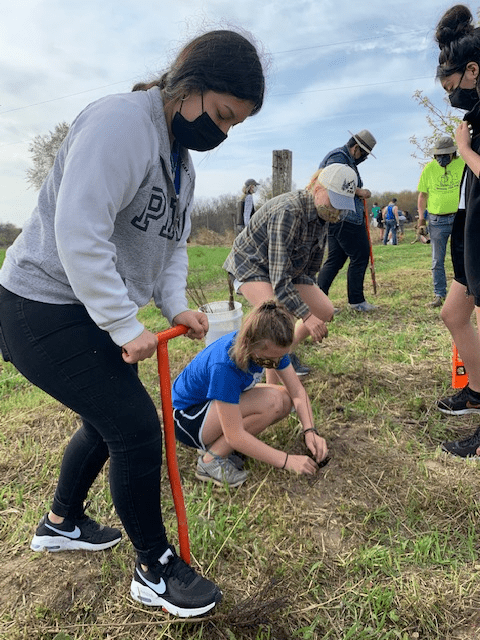

    On both days a statement was read out loud, acknowledging that the land was home to indigenous peoples before the church was founded there, and that the planting project is part of the congregation’s work of reconciliation with indigenous peoples

    “We wanted to do this as part of our commitment to caring for God’s creation, both now and for future generations,” said Brenda Horst, a member of Landisville Mennonite who helped organize the project. “But we couldn’t have done it alone. We really relied on the expertise of the Alliance for the Chesapeake Bay and volunteers from the community get this done.”

    In addition to volunteers from the church and from the Alliance, volunteers came from Hempfield High School, Franklin & Marshall College, Etown College, local Boy Scout Troops, Interfaith Partners for the Chesapeake, Lancaster Conservancy, Hope United Methodist Church, and several Mennonite congregations.

    Ryan Davis, the Pennsylvania Forest Projects Manager at the Alliance, helped plan the project and led the plantings both days.

    “The tree planting went very well on Saturday! We have had large groups before but never so many on site at once,” said Davis. “The seeding and tree planting days were just the very beginning of the process. We can expect the meadow to begin benefitting pollinators and other wildlife next spring, as the vegetative diversity there skyrockets relative to when it was a crop field. Rain infiltration will improve by the second year and we will begin to sequester carbon in the soil within just a few years.”

    In addition to the support from The Alliance for the Chesapeake Bay, Landisville Mennonite received a grant from Interfaith Partners for the Chesapeake for the meadow seed. Mennonite Men, the men’s organization for Mennonite Church USA, also gave a grant for the tree seedlings as part of JoinTrees, Mennonite Men’s campaign to plant one million trees by the year 2030.

  • Congregation comes together to plant 640 trees

    Congregation comes together to plant 640 trees

    ​On two Saturdays in November, volunteers gathered at Landisville Mennonite Church to convert 3.65 acres from farmland into forest and meadow as part of the congregation’s efforts to improve water quality, expand pollinator and wildlife habitat, and address climate change. On November 6, over 80 volunteers planted meadow seed on 1.25 acres, and the following Saturday, November 13, over 100 volunteers planted 640 tree seedlings on 2.4 acres.


    On both days a statement was read out loud, acknowledging that the land was home to indigenous peoples before the church was founded there, and that the planting project is part of the congregation’s work of reconciliation with indigenous peoples

    “We wanted to do this as part of our commitment to caring for God’s creation, both now and for future generations,” said Brenda Horst, a member of Landisville Mennonite who helped organize the project. “But we couldn’t have done it alone. We really relied on the expertise of the Alliance for the Chesapeake Bay and volunteers from the community get this done.”

    In addition to volunteers from the church and from the Alliance, volunteers came from Hempfield High School, Franklin & Marshall College, Etown College, local Boy Scout Troops, Interfaith Partners for the Chesapeake, Lancaster Conservancy, Hope United Methodist Church, and several Mennonite congregations.

    Ryan Davis, the Pennsylvania Forest Projects Manager at the Alliance, helped plan the project and led the plantings both days.

    “The tree planting went very well on Saturday! We have had large groups before but never so many on site at once,” said Davis. “The seeding and tree planting days were just the very beginning of the process. We can expect the meadow to begin benefitting pollinators and other wildlife next spring, as the vegetative diversity there skyrockets relative to when it was a crop field. Rain infiltration will improve by the second year and we will begin to sequester carbon in the soil within just a few years.”

    In addition to the support from The Alliance for the Chesapeake Bay, Landisville Mennonite received a grant from Interfaith Partners for the Chesapeake for the meadow seed. Mennonite Men, the men’s organization for Mennonite Church USA, also gave a grant for the tree seedlings as part of JoinTrees, Mennonite Men’s campaign to plant one million trees by the year 2030.


  • Anabaptist tree planting campaign plants over 2,250 trees this spring

    Anabaptist tree planting campaign plants over 2,250 trees this spring

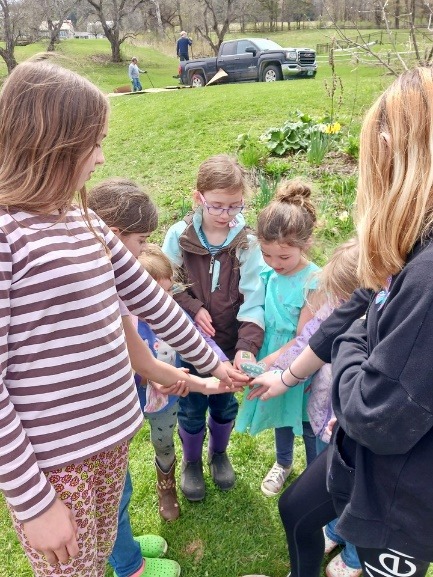
    This spring Anabaptist communities have been enthusiastically planting trees, with over 2,250 trees planted in April alone. Congregations, farmers, men’s groups, and schools have partnered with Mennonite Men to plant trees as part of Mennonite Men’s campaign, JoinTrees, with the goal of planting one million trees by the year 2030.

    Steve Thomas, Mennonite Men U.S. coordinator and certified arborist, has encouraged JoinTrees partners to be creative in their planting projects. The results have been intergenerational events at a variety of sites, including tree plantings at churches, farms, retreat centers, and along the Indiana Toll Road.

    In addition to the various planting events, Mennonite Men’s board of directors also approved $8,247.00 for 5 grants to congregations, farms, and environmental education projects to assist them in tree planting projects they’re undertaking this spring and fall.

    One of the grants helped finance tree planting at Full Circle Farm in Three Rivers, Michigan, where farm owners Gabe and Bethany Bauman-Baker enlisted the help of students from Bethany Christian School in Goshen, Indiana. Students helped them plant 632 trees to create a fast-growing windbreak between their field and the conventionally farmed fields beside them and increase carbon capture.

    ‘We have three goals with this campaign to restore God’s earth,’ said Steve Thomas. ‘Doing our part to care for God’s creation, we aim to mitigate global warming, serve climate justice, and sustain biodiversity.’

    ‘We continue to receive inquiries about how to participate in our campaign,’ said Thomas. ‘People are seeking to join this campaign by offering land to plant, making contributions to fund tree planting, and helping to plant seedlings. We are excited by the strong, positive response across the church.’

    To date, 9,151 trees have been planted through the JoinTrees campaign. To learn more about JoinTrees and how you and your community can get involved, visit mennonitemen.org/jointrees.


  • EMHS students brave cold to plant American Chestnut trees

    EMHS students brave cold to plant American Chestnut trees

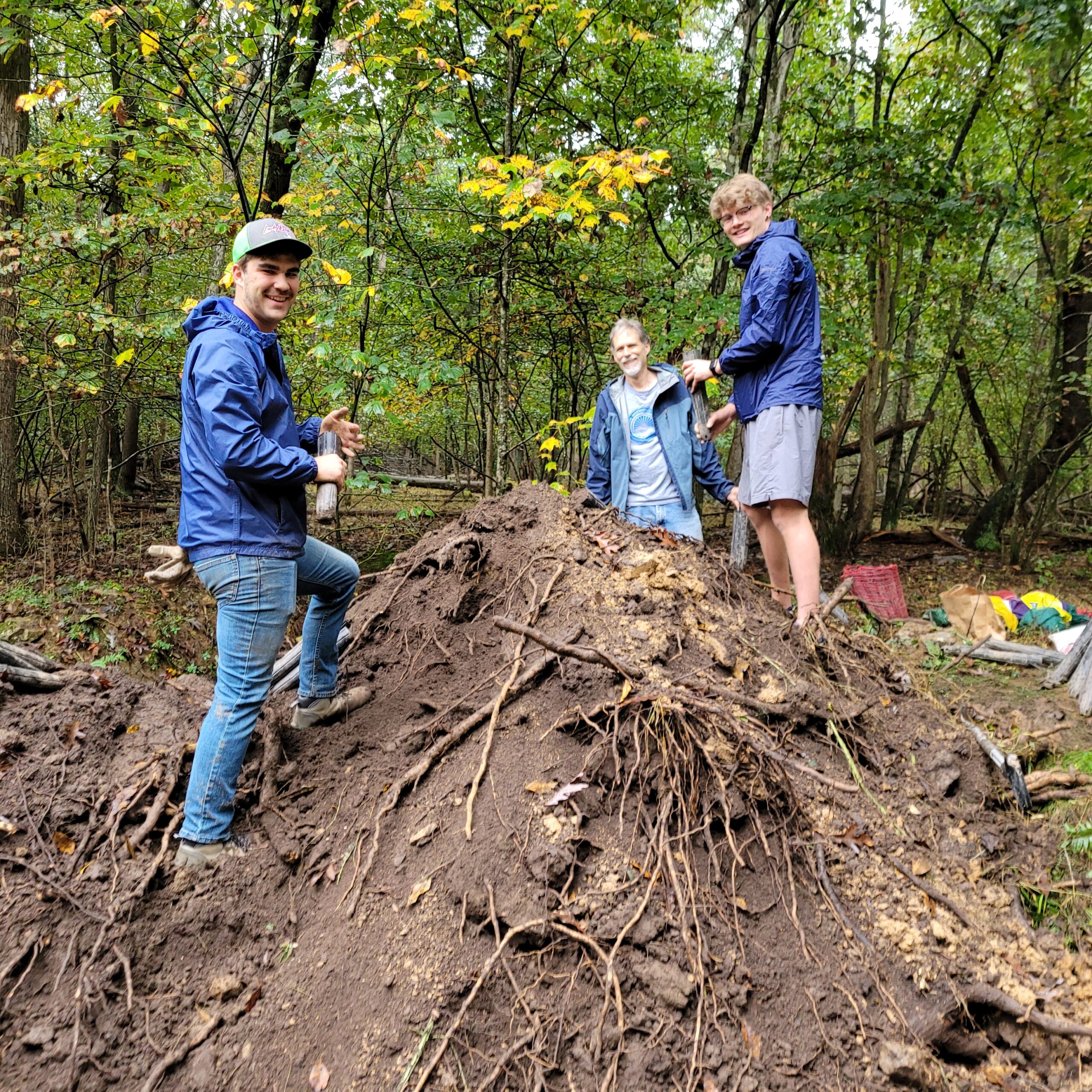
    On February 27, a group of students from Eastern Mennonite High School braved wintery conditions to plant 220 seedlings of the American chestnut tree.


    ‘We had forecasts of inclement weather, which included up to an inch of freezing rain and ice. It created a lot of challenges to our planting plans,’ said Loren Hostetter a volunteer with the American Chestnut Cooperator’s Foundation (ACCF) who coordinated the planting. ‘However, we had a group of very energetic and determined students who would not be denied the chance to participate!’


    The planting was funded in part through a grant from JoinTrees, a campaign launched last fall by Mennonite Men, the men’s organization of Mennonite Church Canada and Mennonite Church USA, to plant one million trees by the year 2030. While some individuals and organizations have funded their own tree planting initiatives as part of JoinTrees, this is the first planting funded by a grant from JoinTrees.

    ‘This first project with Mennonite Men funding was especially exciting as it was part of an important work of restoring the American Chestnut,’ said Steve Thomas. ‘With this we are not simply planting any tree, but a keystone species in the ecology of God’s creation in eastern hardwood forests.’

    The planting is part of a larger initiative of ACCF to reintroduce the American chestnut, a native species once the dominant tree in the Appalachian range, after it became functionally extinct from the American chestnut blight (Cryphonectria parasitica) in the 1920-1940s.

    Although the group’s goal had been to plant 300 seedlings, they needed to limit it to 220 seedlings because of weather conditions and restrictions on how many people could participate in the planting due to Covid. Hostetter said that they plan on concluding the planting in September when they will have more favorable weather.

    To find out more information about the JoinTrees campaign, visit mennonitemen.org/jointrees. If you, your congregation, or your organization would like to support JoinTrees or get involved, please contact Mennonite Men at mm@mennonitemen.org. Photo courtesy of Loren Hostetter