Growth at Assembly Mennonite Church in Goshen, Indiana, is benefiting a congregation 650 miles away.
When Assembly Mennonite enlarged its facilities, it tithed a portion of the project expenses to aid others.
A program called JoinHands, operated by Mennonite Men, helps churches that have the resources for major capital improvements share money with churches in need of help buying or building a place to worship.
And that’s what happened in this case. JoinHands was the conduit to channel the Assembly Mennonite tithe to Mara Christian Church, near Charlotte, North Carolina.
‘We feel it’s the right thing to do, for more established congregations to help the newer ones,’ said Steve Thomas, U.S. Coordinator for Mennonite Men. He describes the essence of the program as ‘congregations thinking beyond themselves.’
The global reach of JoinHands
JoinHands has delivered grants to churches throughout the world and all over the United States and Canada.
Thomas figured Assembly Mennonite would want to help other building/facilities programs as it launched its own. ‘I knew they think carefully about their resources and the needs of other churches.’
As Lora Nafziger said, ‘It’s part of the DNA of the congregation’ to tithe when starting an improvement project. Nafziger is Pastor of Christian Formation at Assembly Mennonite.
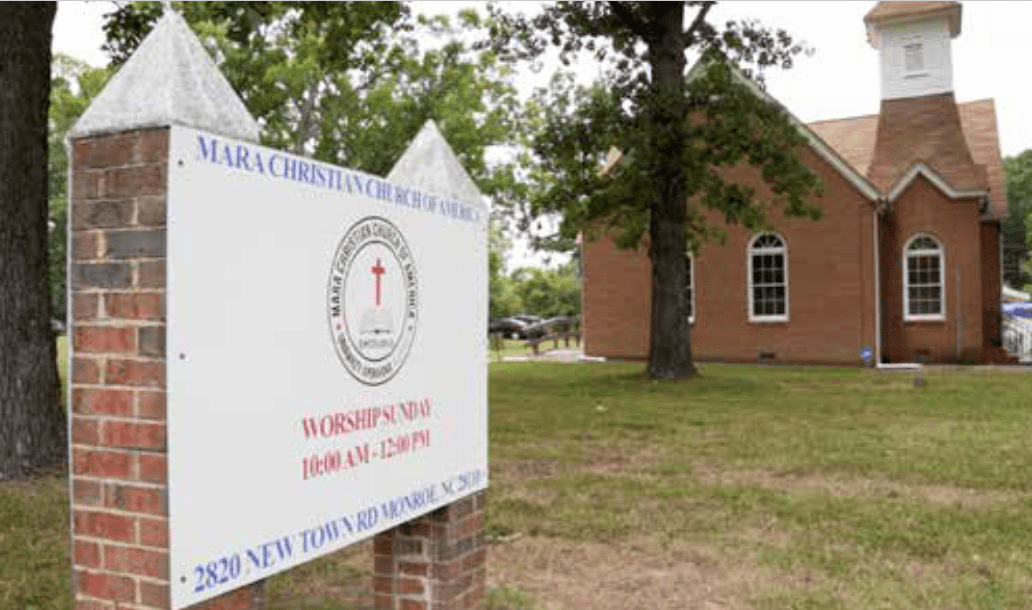
Mara Christian Church, a growing congregation composed mostly of people who moved to the U.S. from Myanmar (formerly Burma), now owns the church building it had rented. The JoinHands grant the church received made that transformation possible.
Members of the North Carolina congregation are ‘thinking about their lives as people of God. The spiritual vitality there is good for others to see,’ Thomas said.
Thomas added that Mara Christian Church members invested a good deal of ‘sweat equity’ in renovating the church building it purchased.
Those who receive JoinHands grants ‘often are people without a history of power and privilege,’ Thomas said. ‘Often, they’re people coming from a situation of real need.’
JoinHands is patterned after 2 Corinthians 8, in which Paul wrote about abundance and reciprocity, Thomas said. ‘That’s our key text.’
He added, ‘It’s an Anabaptist perspective – not just a Mennonite perspective.’
One church helping another ‘is an issue of stewardship, so it linked naturally to Everence,’ Thomas said.
Everence® church loans have helped several established churches (including Assembly Mennonite) that shared some of the money associated with major projects to aid younger churches.
Bursting at the seams
Why did Assembly Mennonite need to expand? Sunday morning attendance has grown by about 20% in the last 10 years, and the once-adequate facilities weren’t so adequate.
Attendance now averages about 230, and has climbed above 300 several times.
Nafziger said church members were talking about the need for an expansion when she arrived at Assembly Mennonite in 2013.
The room used for worship also was the only room large enough for after-worship activities, so chairs were shifted around and tables set up, if needed.
In other words, the sanctuary and fellowship hall were one and the same. An overflow seating area was filled to the most distant corners for most services.
That room now is more of a true fellowship hall, as the more than 5,000-square-foot addition includes the new worship space, which features a similar, barn-like beam structure as the older room.
Diamond shapes are scattered throughout the building in the tile, stone and steel as a physical embodiment of a familiar quilting pattern, Nafziger said.
Church members did much of the work themselves, with Dana Miller of Dana Miller Building Solutions as general contractor. Miller, an Assembly Mennonite member, also oversaw previous expansion projects there, including a big one in 1994.
Nafziger said more than 75 church people were involved in various facets of the project. And member Susan Nelson volunteered to serve as project manager.
The congregation moved into its new spaces in May 2019, and officially dedicated the expansion the following September.
How did Assembly begin?
Assembly Mennonite formed in 1974 when several house churches and small groups decided to assemble for worship on Sundays.
Participants started talking about buying a property for congregational use about two years later.
In 1978, an empty factory building on South 11th Street was purchased, and members did much of the renovation work to create a space for worship, day care for children and a rental apartment.
The first part-time staff person was hired in the 1980s and more property was purchased next to the meetinghouse.
A major building expansion took place in 1994 – a new worship space and three classrooms to be shared with Walnut Hill Day Care and Faith Mennonite Church.
The Walnut Hill operation – now called Walnut Hill Early Childhood Center – moved to its own building in early 2018.
Faith Mennonite Church still shares the Assembly building, worshipping on Sunday evenings.
The Assembly mission statement is: Assembly Mennonite Church seeks to be a dynamic Christian community by together meeting God, who draws us beyond ourselves into nurturing, sharing and living the good news of God’s love as known in Jesus Christ.
A participatory congregation
Assembly Mennonite is a bit unusual in that the church has four pastors – all of whom are part time.
‘We have monthly congregational meetings,’ Nafziger said. ‘We do everything by consensus.’
Karl Shelly, Pastor of Community Building and Mission, said Assembly is intentional about having part-time pastors.
‘This decision is rooted in its desire to be a ‘participatory congregation’ where many aspects of congregational life are carried out by the congregation,’ Shelly said.
‘For example,’ he said, ‘for every 10 sermons delivered at Assembly, pastors might deliver two of them.’ And many aspects of what some might term ‘pastoral care’ are done by Assembly small groups.
As a less ‘pastor-centric’ church than many, ‘the congregation has made the decision that, at least so far, it does not want full-time pastors and the different kind of authority or reliance on professional leadership which comes with that,’ said Shelly.
Anna Yoder Schlabach, Pastor of Worship and Pastoral Care, joined the pastoral team in November 2018 and Scott Coulter, Pastor of Congregational Life and Hospitality, joined the pastoral team in October 2019.
Written materials for visitors note that, ‘Assembly is actually the assembly of small groups, and Sunday morning corporate worship is only part of our life together.’
Jim Miller is a writer and editor at Everence and managing editor of Everyday Stewardship.