by Jon Zirkle
28 ‘Come to me, all you that are weary and are carrying heavy burdens, and I will give you rest. 29Take my yoke upon you, and learn from me; for I am gentle and humble in heart, and you will find rest for your souls. 30For my yoke is easy, and my burden is light.’
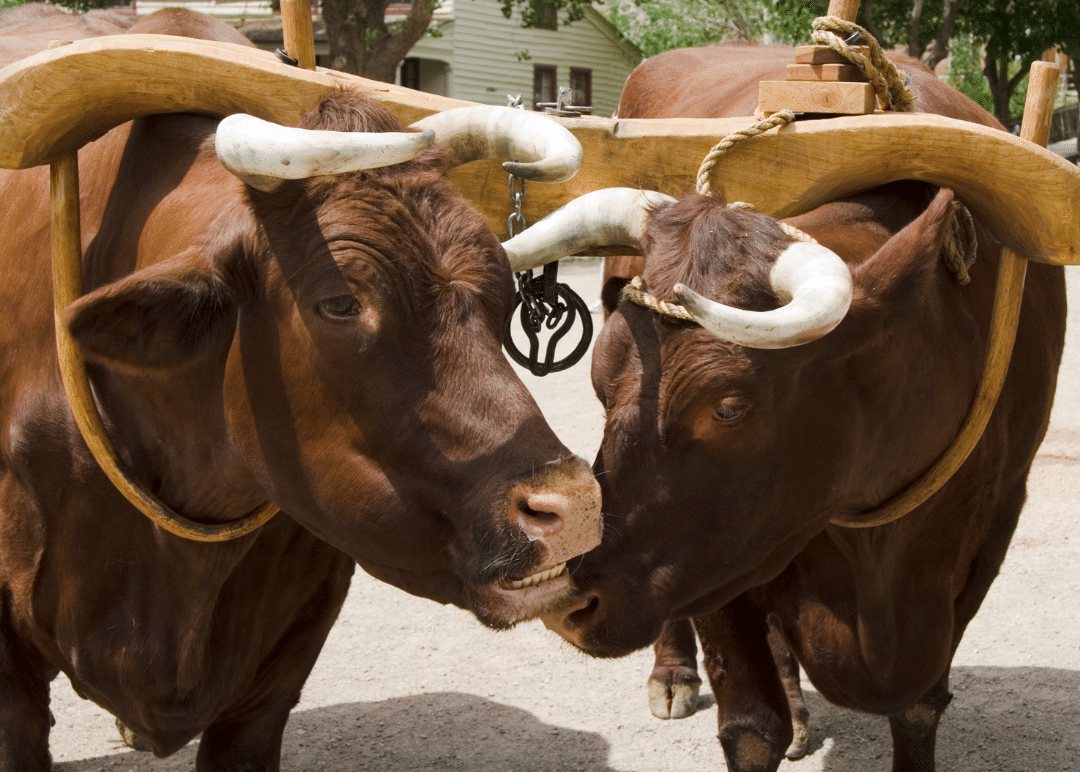
I love this passage from Matthew 11:28-30, especially given the agricultural imagery of taking on a yoke. This passage didn’t make as much sense to me until I visited an animal husbandry organization where I saw and felt handmade yokes. These yokes were purposefully made out of lightweight wood, and they were designed to bring together two animals—usually oxen—to share their work side by side. Many cultures around the world rely on livestock to cultivate soil or carry heavy loads far distances. Perhaps better than most in the US and Canada today’, people who work with livestock understand this imagery well. Jesus calls us into partnership, side by side as companions and co-laborers.
This imagery from Matthew’s gospel helps inform my take on the work of partnership and following in Jesus’ way towards God’s shalom. We walk in step with other followers to carry daunting loads together, not alone. Mennonite Men aims to walk and work in solidarity with partner organizations, church conferences, and congregations towards a Jesus-centered justice. We cannot do our work alone or in isolation.
I want to highlight some examples of how partnership is playing out for Mennonite Men right now and how we are confronted by Christ’s calling towards justice as we do so. Our longstanding ministry called JoinHands (once called Tenth Man) has given out grants to newer congregations who wish to purchase their first building. Over $2,000,000 has been given out over 40 years to over 90 individual congregations in the United States, Canada, and countries around the world. Praise God!
Photo: Canva Pro
In recent years Mennonite Men has not received many JoinHands applications from US and Canadian congregations. Applications we do receive are often from immigrant and refugee congregations. Congregations of immigrants and refugees in the United States may struggle in working with banks and getting loans, potentially facing hardships and discrimination when doing so. I suspect many Mennonite congregations of European descent are successfully funding the purchase of new buildings internally and perhaps are successfully acquiring traditional bank loans. Matters of fairness, privilege, and discrimination quickly show themselves.
On the other hand, Mennonite Men is increasingly receiving more JoinHands grant requests from congregations in Africa and Southeast Asia. With international grant applications, our partners play an essential role for Mennonite Men in better understanding the congregation and their context if we can’t dialogue directly with the congregation. For example, I spoke with Mennonite Church Canada’s Witness Liaison, Norm Dyck, earlier this summer by Zoom who helped share insights about a JoinHands grant application coming from a congregation he knows of in Myanmar. And our ongoing partnership with Africa Inter-Mennonite Mission (AIMM) has helped connect Mennonite Men with African congregations applying for JoinHands grants and JoinTrees grants. As I’ve learned from the late Executive Coordinator, John Fumana (who died tragically in May 2026), and Interim Coordinator, Tara Burch, AIMM also does an incredible amount of cultural translation, language translation, and technological legwork to help some applicants fill out Mennonite Men grant applications.
Through partnership Mennonite Men discovers so much, and what we discover is humbling and transformative for North American Mennonites. It is very humbling to discover the many layers of additional work that applicants whose first language is not English or who do not have reliable internet for digital communications have to go through simply to apply for a grant. We are also humbled by the disparities of resources and stability (geopolitical and climate-related) between applicants that shapes the reasons they are applying in the first place. JoinHands applications from communities in Global South countries are often worshipping outdoors with no structure or in structures with no roof or in structures made of salvaged wood and sheet metal that are vulnerable to inclement weather and theft. Many JoinTrees grant applications coming from the Global South propose growing trees that will provide food, fiber, and economic livelihood as well as protection from oppressive tropical heat. Our international sisters and brothers applying for grants are living daily with severe deforestation, poverty, hunger, violence, and war-ravaged landscapes.
I return to the Matthew 11 image Jesus gives us of being yoked together with him, the imagery and invitation this gives us for how to follow in his ways. Jesus invites us into deeper and even more vulnerable territory of partnership. When agree to being yoked together with our partner, we see and hear and feel up-close what our fellow sister or brother is experiencing. Both parties are changed. And, both partners have more stability to move forward together towards God’s shalom. The burden is lighter indeed.
Mennonite Men is at a threshold, one in which I believe Jesus is showing us the disparities that exist among God’s people. Following Jesus for God’s shalom may involve some deeper looks into and making changes to our policies. Doing our work may mean getting more intercultural competency training and more intentional relationship building with partners of varying backgrounds. We need to build our capacities for greater relationship.
I invite you, your congregation, your conference, or your company or organization to support our work and our commitment to partnership through prayer, through amplifying our messages (and sharing about our work online and verbally), and through financial gifts. Help us continue taking steps forward into the work of love, rooted in the ways of Jesus.