
Tag: Jon Zirkle

  • Following Jesus as Males in 2026

    Following Jesus as Males in 2026

    Submitted by Jon Zirkle

    The Christian Bible gives us four accounts of Jesus.  We see different angles of Jesus—Jesus as a baby, as an adolescent, and as an adult man. Jesus appears to his disciples after his death.  Stories describe his birth and his brutal execution, his adult experiences of escaping to wilderness for prayer, walking long distances, healing sick people and casting out demons, crossing boundaries and facing taboo head-on, feeding others, riding on donkeys unarmed.  As a male Jesus had a life full of experiences that involved risk.

    Here in 2026 living on the North American continent, displays of masculinity constantly confront us in the media, online, at sporting events, and in politics.  Boys and men daily see images of men who dominate on the field, in the bedroom, and in the workplace.  Often the images in ads are of men alone, solo heroes.  We see men who refuse to admit wrong-doing, men who abuse and steal without consequences, men driving big trucks through rivers and over huge boulders, men worshipped for their chiseled bodies.  Men are portrayed as above reproach, measured by their financial worth, have things under control and are in control. 

    These images are vastly different than what we hear in the stories of Jesus.  The Jesus I witness was a man who forgave others, a man who left behind a normal way of life in order to share good news and help others who suffer, a man who wept openly and cried out to God, centered love and service, could express joy and took time to celebrate with friends, and regularly depended on a group of men.  The Jesus I read about was not married with children, did not own a house or many possessions, was bullied and taunted and threatened, and didn’t retaliate towards enemies.  He was obedient to that which was beyond him, to his Creator.  He believed in the power of prayer.  He was willing to publicly die in a humiliating way. I can only imagine the kind of bullying, name-calling, and taunting Jesus would experience if living in 2026. 

    Are we—am I—ready to follow Jesus?

    Following Jesus as a male in 2026 in North America is feeling pretty radical.  Let’s be real.  We—myself included—are continually tempted to believe that we don’t need help from others, that work and making money are more important than offering love and service, that “our” time is better spent working out than in prayer and fellowship.  Porn, fierce competition, displays of unfiltered anger and violence, and celebrations of war and military service abound.  This can all feel overwhelming.  I believe we men need support, a healthy sense of self, a commitment to prayer, and vulnerable brotherly community to follow Jesus’ alternative path. 

    If you identify as male and you’re reading this right now, I hope you know that you are not alone if you are struggling to resist the forces that bombard us as men.  I hope you know that your life, your story, your gifts, your body, the person that you are really matters in this life and beyond.  I hope you can hear God’s voice that calls your name, that you feel permission to lean into the messages of Jesus, rejecting false idols of empire and domination. 

    I hope you’ll join other men who want to try to follow Jesus.  If you (or another male in your life) do not have community, consider attending a men’s retreat or to join or start a men’s group, which could be an online group.  Identify a friend, family member, co-worker, therapist, pastor, or another mature person you trust who might help you connect or might even join you in your search for fellowship.  Reach out to us at Mennonite Men by e-mail for ideas. Explore our resources, books, and videos found at https://mennonitemen.org/joinmen/.  Brothers, you are in our prayers.

  • Malleable Men: A Mennonite Men Retreat at Camp Friedenswald

    Malleable Men: A Mennonite Men Retreat at Camp Friedenswald

    By: Jon Zirkle

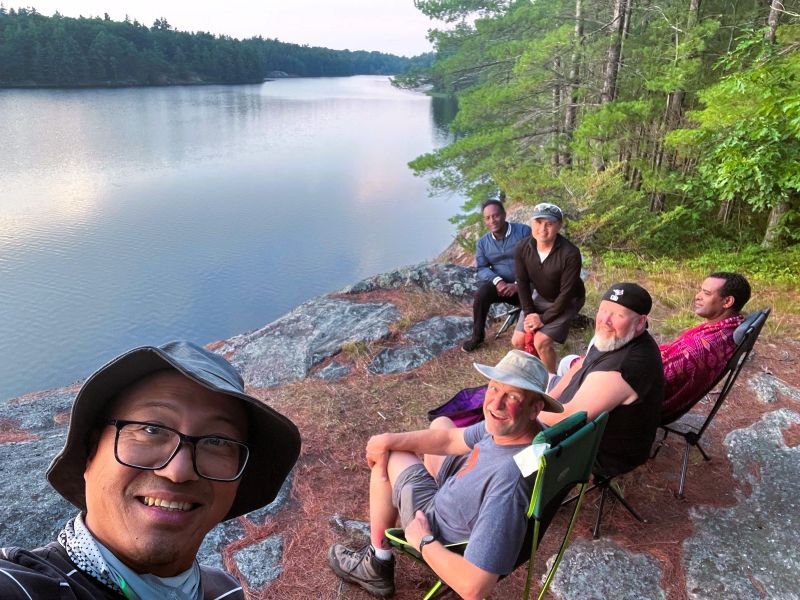
    On the first full weekend of March, twenty-eight men gathered at Camp Friedenswald in southern Michigan for a Mennonite Men retreat. The COVID-19 pandemic and other reasons had led to a pause in this annual retreat for several years, and many celebrated its return. Rarely, if ever, had this retreat been offered in the spring during the Lenten season. One never knows if early March in the Midwest could bring snowstorms, thunderstorms, or heavy rain, all capable of canceling a retreat. But despite a nearby tornado on Friday afternoon, weather did not cancel this long-anticipated gathering. Praise God!

    The theme, Becoming Malleable Men: Practicing Faith and Being Formed, was shaped largely by Mike Martin, Executive Director of RAWtools. Unfortunately, Mike came down with the flu days before and was unable to travel from Colorado. Nonetheless, gifted camp staff and his already-prepared content allowed the retreat to proceed, one where we truly practiced malleability together. All arrived safely, even those coming from as far as Wisconsin and Colorado.

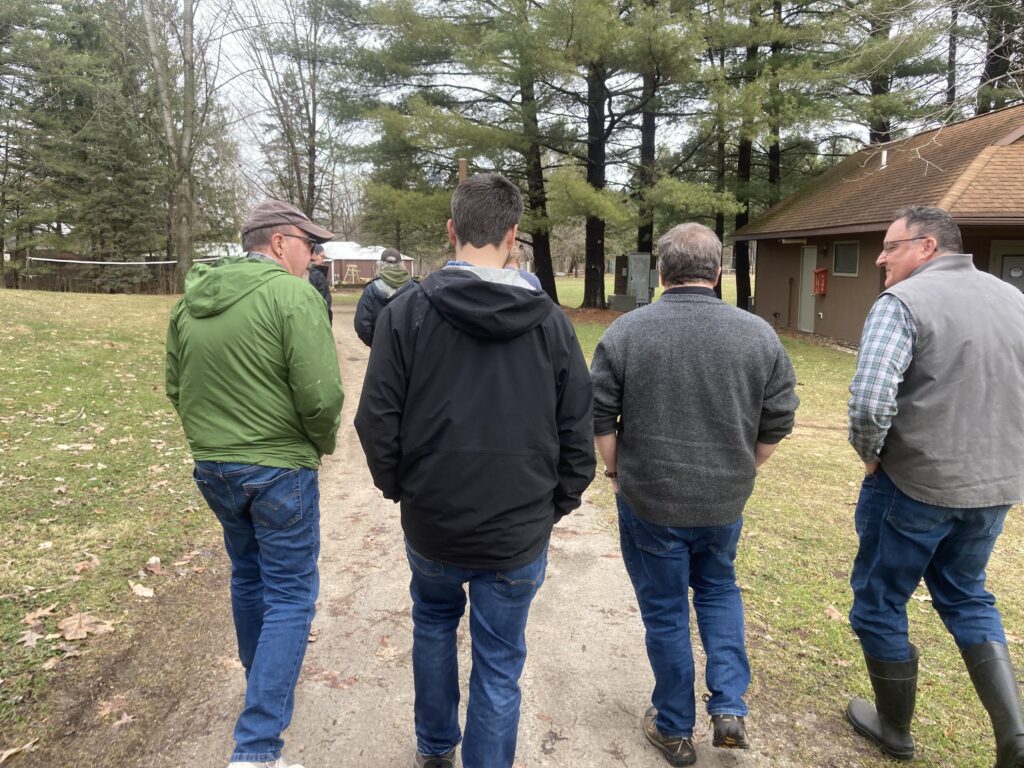
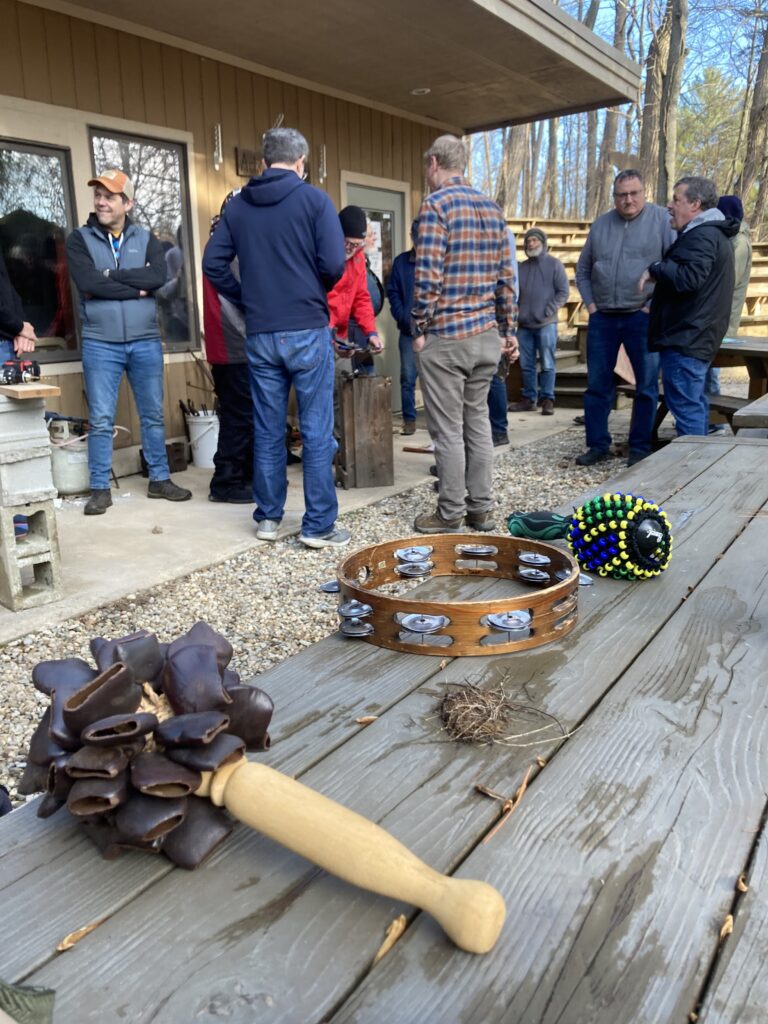
    Throughout the weekend, God’s creation provided rich symbolism for unpredictability, beauty, and adaptability. Heavy rain and thunder on Friday night moved our campfire indoors, where the fireplace and acoustics drew us together beautifully for prayer and singing. Several men jumped into icy Shavehead Lake on both Saturday and Sunday morning, a real bonding experience. Saturday’s mild weather allowed a hike to see thousands of young native trees planted through a Mennonite Men JoinTrees grant, and camp staff Amy Huser and Jonathan Fridley shared about land management and creation care.

    Saturday afternoon was a highlight for many. Optional activities included disc golf, cutting invasives, archery, forging metal, and chopping wood as service to camp. The evening closed with popcorn and fireside singing at Mosquito Hollow, a long and beloved camp tradition.

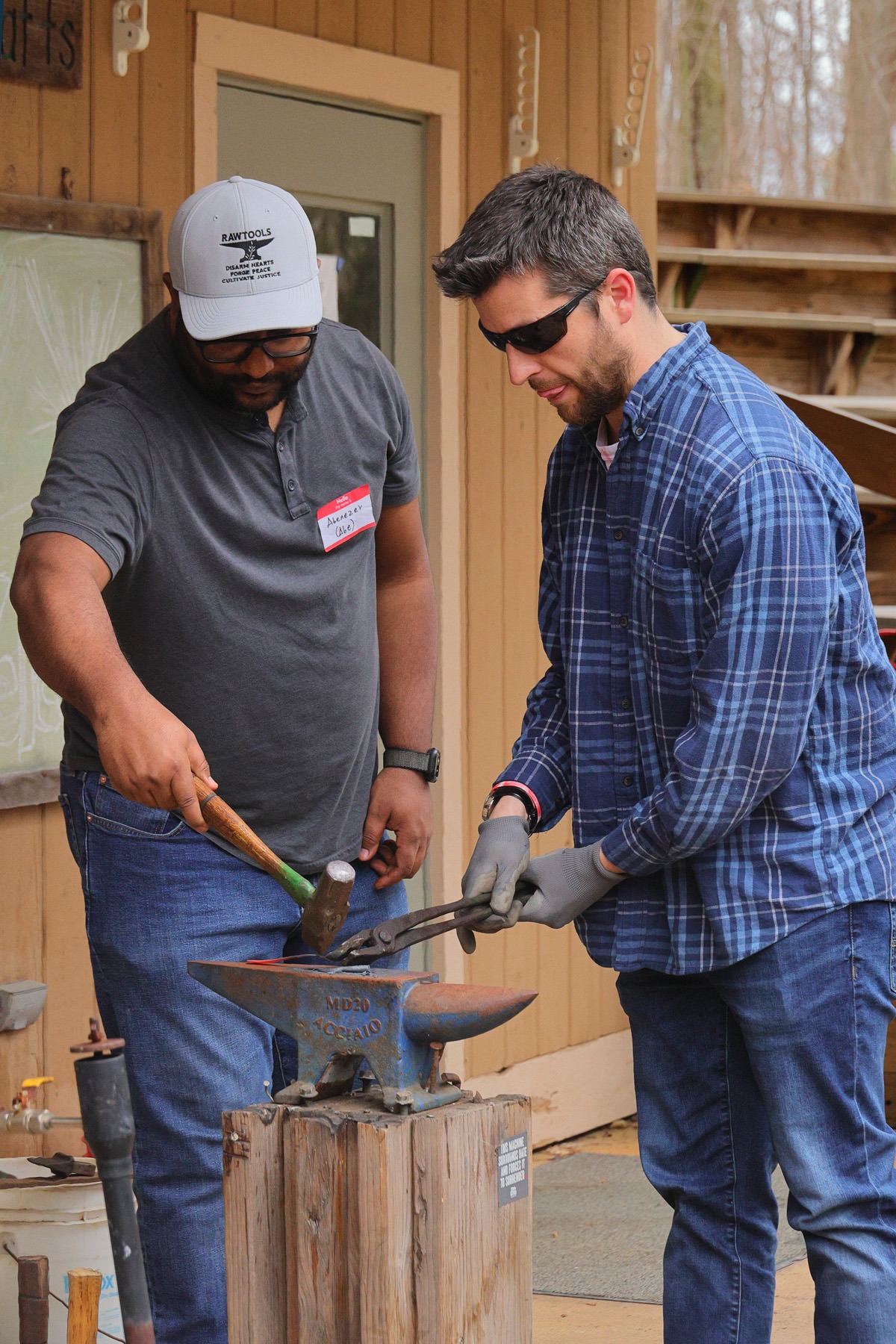
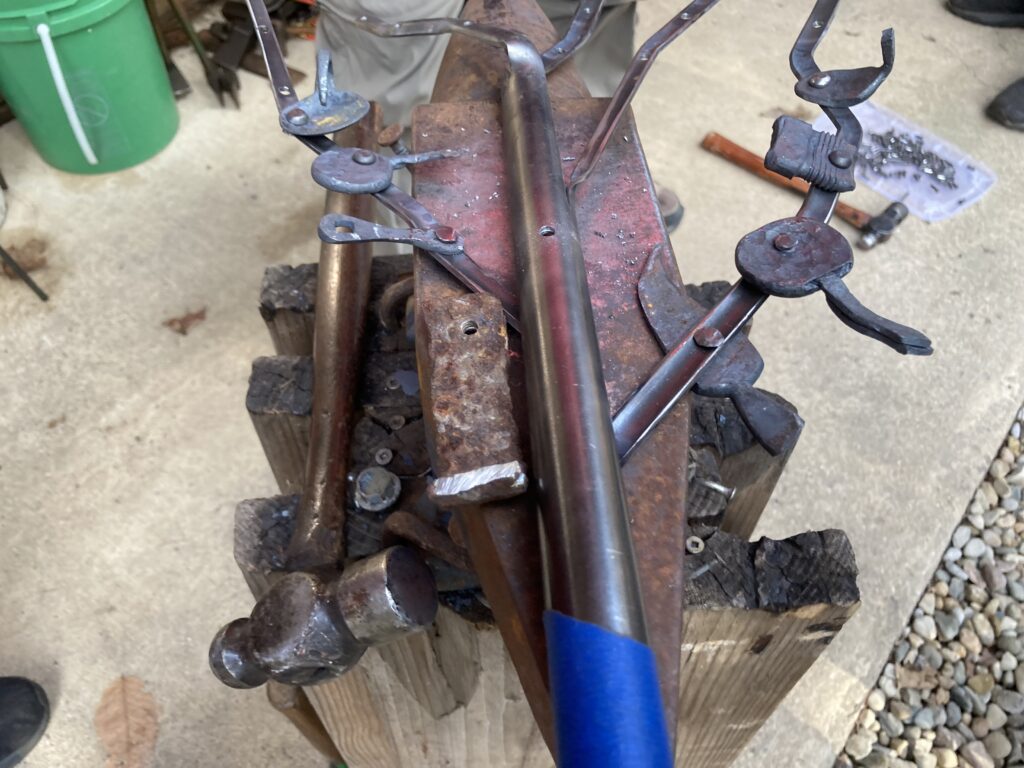
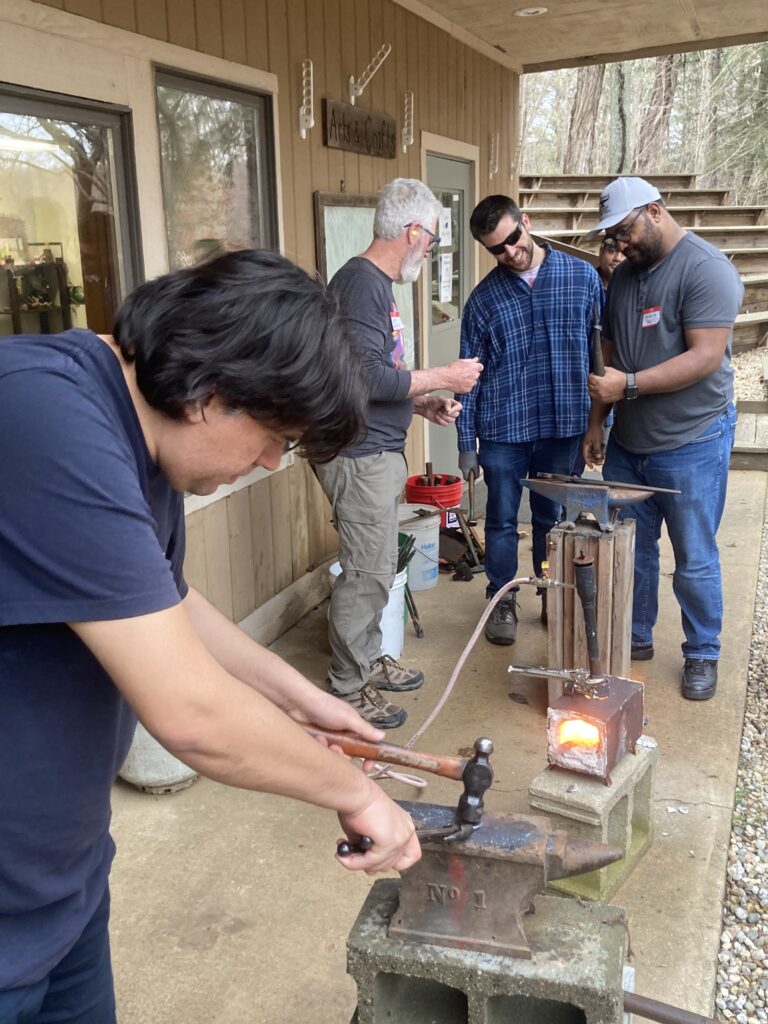
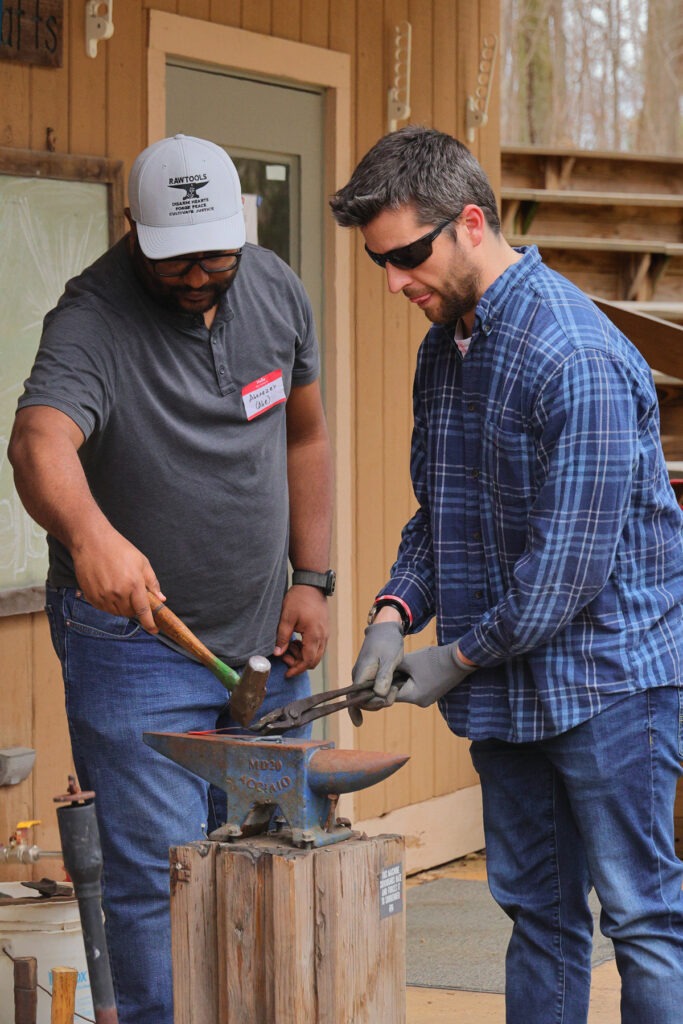
    A focal point of the weekend was forging metal pieces brought from home alongside decommissioned weapon parts from RAWtools’ peacemaking programs. Volunteers Jerry Martin and Abenezer Dejene guided us as we worked in pairs, each altering their partner’s forged piece in some way. Letting others shape our work physically teaches us to learn from one another rather than compete for control.

    On Saturday night, we forged in the dark by headlamp, then reflected in small groups. Mike Martin’s words have stayed with me: “The transformation I see at the anvil has so much carry-over into our transformation throughout life. It connects to conflict and harm and repair and reconciliation. We have plenty of good things that have shaped us as well.”

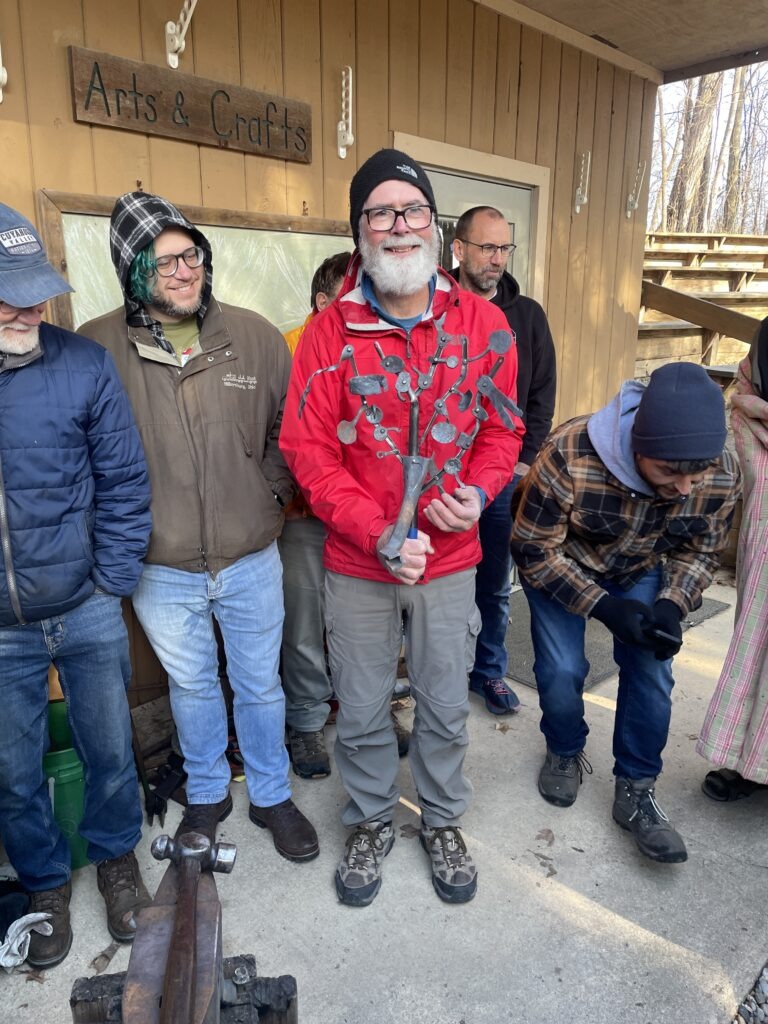
    Sunday morning brought bird watching led by college student Peter Moser, then outdoor worship in glorious sunshine. We sang hymns as we attached our forged pieces to a tree-like sculpture, left at camp as a lasting memory of our gathering. We ended in a prayer circle, new bonds formed.

    Abenezer put it well: “At the Mennonite Men’s retreat, I had an opportunity to fellowship with other men from diverse walks of life. We shared stories about the individuals who have influenced our lives, and took part in forging a piece of gun into something beautiful. The retreat provided a chance to test whether I had forgotten my blacksmithing skills and to reflect on my malleability as one shaped in the likeness of Christ. The fellowship and experience at the Mennonite Men’s retreat were a time of learning and reflection on how we can be shaped to serve others.”

    A question many often ask: do men really need to gather?

    My answer: yes! As brothers and participants in God’s kin-dom, we need each other. Our stories matter. This was echoed by male retreat participants in their evaluation forms. They noted that the vulnerable sharing, small group time, singing, and sharing aloud “I Am From” poems we wrote were the highlights of the weekend.

    Frankly, it’s rare to find sacred spaces where male sharing is deep and personal, where there is trust and respect even when our male experiences and realities differ. Building trust, becoming malleable, and listening well to one another takes practice. We can look to biblical stories of Jesus and the disciples for examples.

    These are challenging times for men in the US, in Canada, and all over the world. I hope you find other men to connect with, be it one-on-one for coffee, in a small group, or at a retreat. Stay tuned for the next Mennonite Men retreat, or reach out if you want to organize a retreat in your neck of the woods.

    Photos by Jon Zirkle and Camp Friedenswald

  • New Building and Thriving Community

    New Building and Thriving Community

    By Jon Zirkle

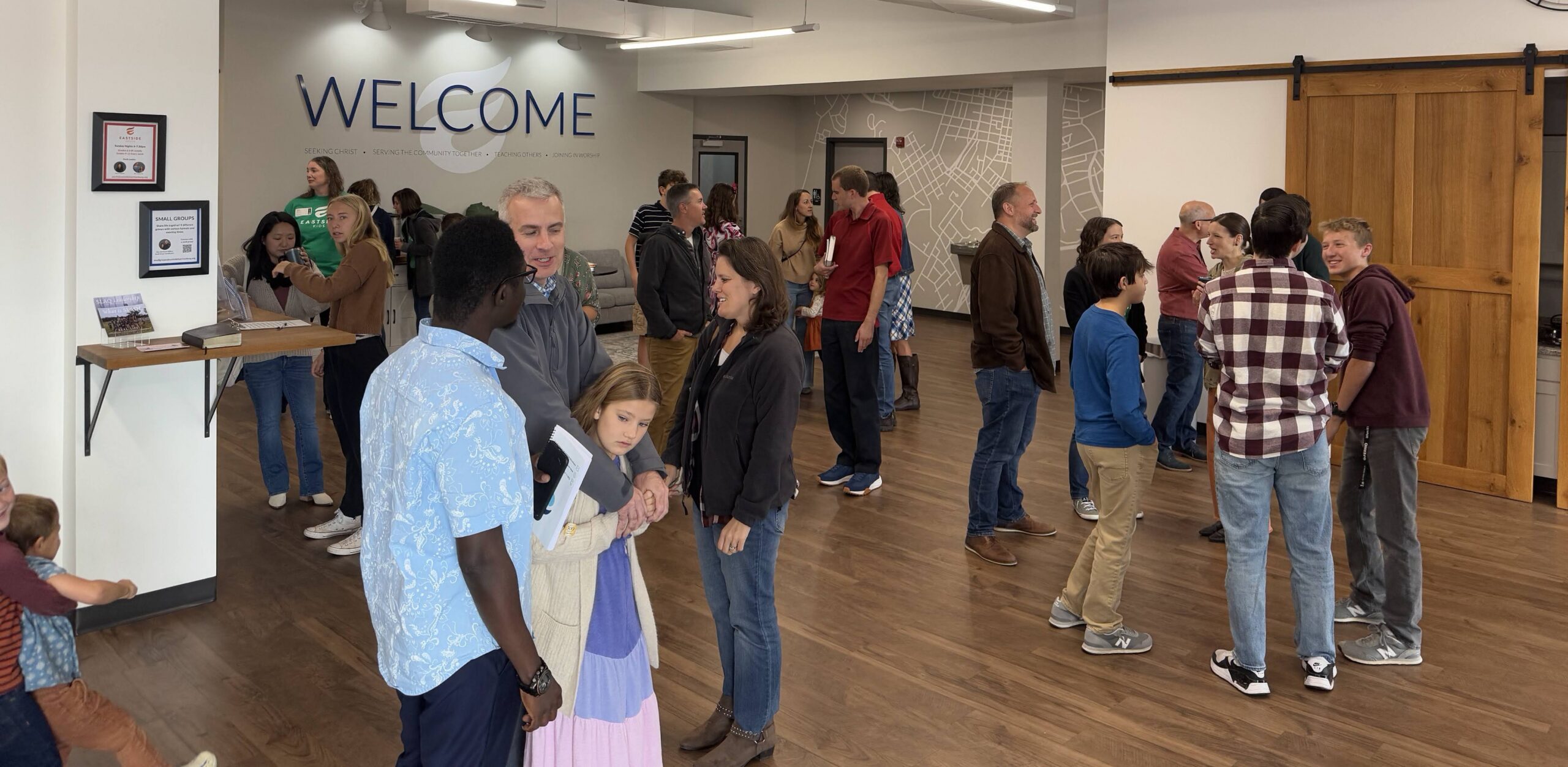
    On Sunday March 15, Eastside Church in Harrisonburg, VA celebrated its 16th anniversary as a congregation.  While on a Mennonite Men visit to Virginia, I had the pleasure to see the building firsthand and later had a conversation with one of the pastors about Eastside past and present.

    For many years the congregation rented worship space, and as many can attest, renting worship space can present some challenges and constraints.  “I don’t know what we would have done during COVID if we were still worshipping in a school,” said pastor Peter Eberly.

     In November 2021 Eastside Church moved into its current building, having raised enough money to purchase the building and secure a loan.  Among several sources of funding, Mennonite Men’s JoinHands program awarded the congregation a $40,000 grant, representing about 10% of the funds Eastside needed to make the purchase possible.  Skipping ahead to 2026, the congregation just paid off one of its loans this week, perfect timing for a celebration. 

    I asked pastor Peter Eberly what impacts the new building has had on the life and mission of the congregation.

    “First of all, our current church building’s location is near a busy intersection.  I estimate that 25% of our current congregation has started attending since we moved into this space.  People see our sign when driving by and decide to check us out,” said Eberly.

    Current attendance at Eastside is approximately 200 people on a given Sunday.  Pastor Eberly noted the remarkable variety of groups and activities now filling the building.

    “Upstairs we have two tenants who pay rent to use space.  On Friday nights, we have over 100 college students come to use our space through Young Life.  On Saturday we have a training for Isaiah 1:17 House, an organization providing physical and emotional support for children awaiting foster placement.  On Sunday mornings we have Haitian folks who come for worship, and after the service many of them stick around for prayer.  All of this is possible because we have space,” says Eberly.  

    I could tell from our conversation that Eastside is a unique congregation and has taken deliberate action to meet people on their faith journey and articulate an Anabaptist commitment.  I could also sense this when reading about them on their website, which states:

    We are firmly in the Anabaptist tradition, but do not find our value or identity within denominationalism. We strive to translate Anabaptist faith to this generation by lowering cultural hurdles, speaking God’s truth to political powers and setting our sights on the Kingdom of God. 

    Join us in praying for Eastside Church and for congregations throughout the U.S., Canada, and around the world who are trying to build their ministry, live out their faith as followers of Jesus, and secure a safe place for worship.

    Mennonite Men’s JoinHands grant program continues to accept applications for new Anabaptist congregations pursuing the purchase of their first worship space.  We hope to receive applications from congregations in 2026, and also want to raise additional funds to bolster this ministry program.  Access to funding for purchasing a building can be challenging for new congregations, and we want to help, continuing Mennonite Men’s long tradition of helping grow the church.  To learn more or to donate to this ministry, visit https://mennonitemen.org/joinhands/ today. 

    Photo credit: Eastside Church

  • JoinMen: A conversation with Isaya

    JoinMen: A conversation with Isaya

    By Jon Zirkle

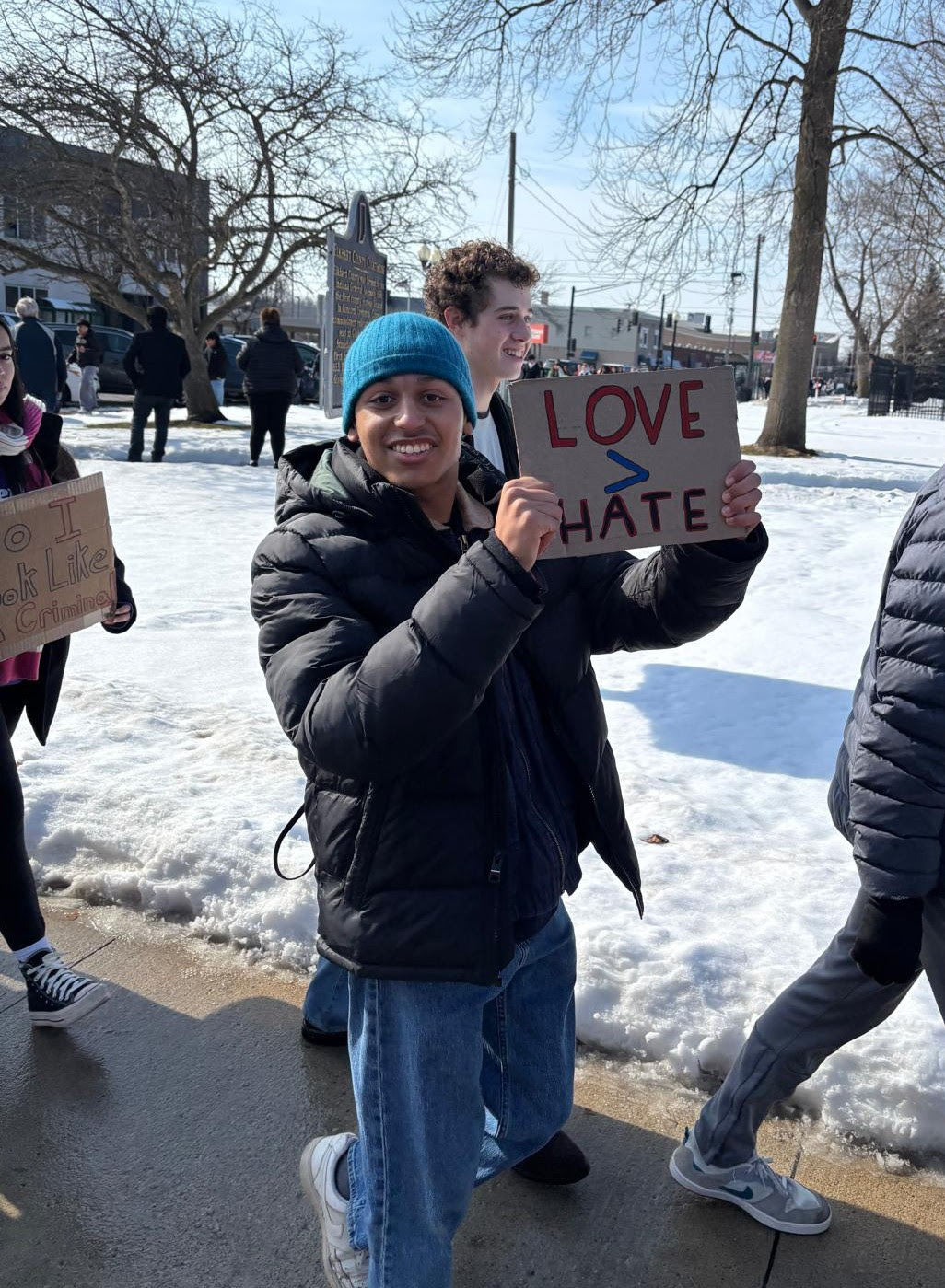
    A few weeks ago, I was in downtown Goshen for a midday meeting and encountered high school students marching to the Goshen courthouse square.   I was moved to see so many young people taking prophetic public action.  Many of them were youth I recognized from nearby Mennonite congregations. 

    One of the youth was Isaya Magatti, a high school junior I know from church who is part of the Mennonite Youth Fellowship (MYF) group.  The next day I saw him and several other MYF members in photos from the march included in our congregation’s weekly prayer and sharing email.  On a number of occasions, I’ve had a chance to hear Isaya read Scripture aloud and make announcements in Sunday morning worship.  His maturity, sincerity, prophetic voice, and heart for justice are noteworthy.  It being Black History Month, I felt it could be a good opportunity to hear from a teenager who identifies as a Black male and possibly write an article for our Mennonite Men newsletter.  I reached out to Isaya’s father, Tobias, to see about interviewing Isaya, and I was grateful that he and Isaya agreed. 

    Meeting up with Isaya for a conversation was both a good opportunity to hear about his experiences and to share about Mennonite Men.  First, we talked about the MCUSA convention back in July that we both attended and its theme, “Follow Jesus”.  I asked how that theme and phrase lands for him.

    “’Follow Jesus’ encompasses faith, following Jesus’ example and his radical approach to making good in the world.  It makes me want to do good in the world, too.”

    When I shared our Mennonite Men mission statement—engaging men to grow, give, and serve as followers of Jesus for God’s shalom—with Isaya, I was moved to hear his reflections. 

    “The last part of Mennonite Men’s mission statement, “…for God’s shalom,” is a good reminder of the end goal, of why we give, grow, and serve, and why we try to follow Jesus”, says Isaya. “It’s for God’s shalom.”

    I asked Isaya what feels significant to him about Black History Month and why it is important to him personally.  Sharing that his mom is from the U.S. and his dad is from Tanzania, he expressed there is a difference for him in relating to Black History as a first-generation American and as someone with an African father.  At times he feels more connection to the words “African” and “American” separately.

    “I don’t feel all that connected to the history of Black culture in the U.S.   That said, the reason I even exist is due to the Civil Rights movement and the legalization of interracial marriages, which is only about 60 years old.  That’s not that long ago.  So, I do feel a really direct connection to the Civil Rights movement.”

    Our conversation wove between topics of what it’s like having brothers, service trips for youth and young people, and how masculinity shows up in everyday life.  Isaya had important points to make and questions pertaining to how Mennonite males can show up online. 

    “How do we follow Jesus in online spaces?  How do we cultivate community in our online age?” he asked. 

    “Part of being people of faith is being in right relationship with other people.  This includes how we interact with others online.  Masculinity portrayed online is usually communicated as taking control, not being weak, and making sure you can dominate situations.  I wonder how we as Mennonites can discuss masculinity online with other men, including with those who fully believe in a masculinity of domination.”

    “There is relationship happening online, both good and bad.  It’s also important to build community outside the online world,” he concluded.

    Men having authentic and respectful conversation with other men of differing life experiences, ages, and racial identities can be a powerful and transformative experience.  I believe that Christ can show up in our midst as we relate in this way.  Though not always the case, we men might also experience greater trust, curiosity, solidarity, joy, and friendship with each other as well.  These are gifts of the Spirit.

    Join me in praying for Isaya and other young Black male Mennonites who strive to follow Jesus and usher in the kin-dom of God by building relationships.  I look forward to ways Mennonite Men can encourage, deeply listen to, and act on the questions, ideas, and leadership gifts of our Black brothers in the Mennonite Church and beyond.