
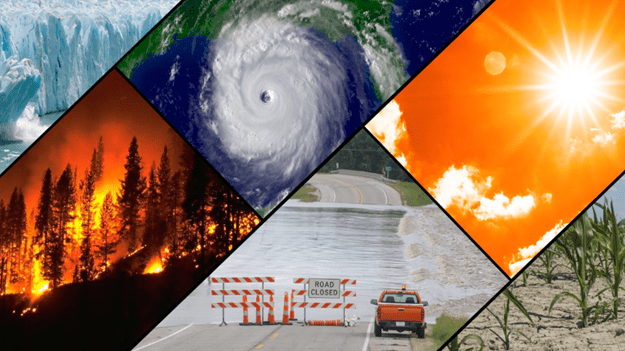
 Our JoinTrees campaign targets climate change, an existential threat to life on our planet. By increasing tree and forest cover, one of our goals with tree planting is to help mitigate global warming.
Does “existential threat to life” overstate the problem? Not according to what is happening on our planet.
The Intergovernmental Panel on Climate Change (IPCC) of the United Nations finds that climate change is widespread, rapid, and intensifying, with increasing temperatures, forest fires, hurricanes, sea levels, drought, and desertification around the world.
The report documents that human-induced climate change is already affecting every region across the globe and that approximately 3.3 to 3.6 billion people live in contexts highly vulnerable to climate change. Vulnerable populations who contributed the least to emissions are disproportionately affected by this environmental injustice. The report projects that global warming is likely to exceed the threshold of 1.5°C in the near term (around 2030–2035) across almost all considered scenarios, increasing the risk of abrupt and potentially irreversible changes in Earth systems. Once past this tipping point, there is an elevated risk of abrupt ice sheet loss, large-scale forest dieback, and other dire natural disasters that will accelerate suffering for most forms of life.*
These environmental changes will lead to humanitarian crises, with food insecurity, scarce resources, health issues, and other population stresses. The National Security, Military, and Intelligence Panel on Climate Change in Washington, D.C., and other security analyses project that these conditions, together with population growth, will contribute to political insecurity, with increasing conflicts, violence, and mass migrations as desperate conditions prompt desperate reactions. Just within the United States, the Fifth National Climate Assessment reports that the U.S. now experiences, on average, a billion-dollar weather or climate disaster every three weeks. Add to all this the loss of biodiversity and the increasing rate of species extinction. All of God’s community of creation is truly threatened.
To counter these threats, we need a range of solutions to reduce greenhouse gas emissions, especially reducing the use of fossil fuels and consuming less meat (which drives forest conversion to agriculture). At the top of natural solutions is protecting forests and planting trees. In a study of 21 distinct natural climate solutions in the United States to increase carbon storage and avoid greenhouse gas emissions, reforestation had the single largest maximum mitigation potential. Other studies have also found that restoration of trees and forests is among the most effective, if not the best, means to help draw down CO₂, slow global warming, and thereby mitigate climate change, because in terrestrial ecosystems, trees account for most of the carbon capture and long-term storage.
Recognizing the role of trees in moderating climate, protecting forests and planting trees are critical—especially to offset continuing deforestation, the second-largest source of climate-warming CO₂, second only to emissions from burning fossil fuels. Since humans began cutting forests, the number of trees on Earth has fallen by about 46 percent. While the rate of forest loss has slowed significantly, global assessments still estimate net forest loss on the order of millions of acres per year. According to recent UN forest resource assessments, the world’s net forest loss is roughly 10 million acres—or nearly 16,000 square miles—per year. What is especially alarming is that some tropical forests that were once a major carbon sink have become a net source of CO₂ in the atmosphere, as they are lost from harvesting and conversion to agriculture to produce beef, soybeans, and palm oil. This contributes to drought, insect infestation, and fires, all of which reduce forest biomass and weaken hydrologic cycles, atmospheric cooling, and carbon sequestration.
Considering what trees do to protect our planet, many forest restoration programs and tree-planting campaigns have been undertaken around the world.
Within Mennonite Church USA, JoinTrees is our tree-planting campaign to protect God’s Earth and the community of creation.
We are roughly one-third of the way toward reaching our goal of planting one million trees. We are grateful for the support we receive to fund and carry out our projects with local communities in the United States and seven other countries. Individuals, congregations, organizations, and businesses make JoinTrees possible.
Some supporters who pay attention to their carbon footprint and seek to make offsets with contributions to JoinTrees are interested in knowing the actual values of tree-planting projects. To help us with this, the Economics of Sustainability class, led by Professor Jerrell Ross Richer, with the assistance of Bill Minter at Goshen College, will calculate the environmental and economic values of some of our projects. We will report on this in a future issue of Engage.
Look for an announcement of our next tree-planting projects with Mennonite partners, and partner with us as we seek to do our part to protect our planet and God’s community of creation.
*Read the latest climate reports:
Fifth National Climate Assessment (2023) and Intergovernmental Panel on Climate Change (2023)